Skip to content
  • About Us
    • Company Profile
    • Our Team
    • Shareholders & Members
    • Opportunities
  • Services
    • Launch of Industry-Driven R&D Initiatives
    • Securing of Research Funding
    • Management of European R&D Projects
    • Management of European R&D Programmes
    • Studies on Strategic Topics in ICT
  • EuresTools®
    • EuresTools Reporter
    • EuresTools Tracker
    • EuresTools Workspace
    • EuresTools Website
    • EuresTools Conferencing
    • EuresTools Mailing List
    • EuresTools Pricing
  • Projects
    • Ongoing Projects
    • Past Projects
  • News
    • News
    • Events
    • Eurescom message
  • Contact
    • Travel information
    • Location
×
Linkedin Youtube
 

5G_footprint_in_broadcast_technology

IEEE International Symposium on Broadband Multimedia Systems and Broadcasting
Anastasius Gavras
Eurescom

The 16th edition of the IEEE International Symposium on Broadband Multimedia Systems and Broadcasting 2021 (BMSB 2021) was planned to be held in Chengdu, China on 4–6 August 2021. Like many other events, also BMSB 2021 was turned into a fully online event due to the COVID-19 pandemic. The symposium is the premier forum for the presentation and exchange of technical advances in the rapidly converging areas of multimedia broadcasting, telecommunications, consumer electronics, and net­-
working technologies.

Overall, the core program of the conference was held according to the published schedule, and the online format only affected the poster and best paper award sessions with a slightly adapted timing.

During the opening of the symposium, three keynote presentations addressed the audience outlining future trends and recent innovations and developments in the sector. Madeleine Noland, President of the Advanced Television Systems Committee (ATSC), USA presented her view on innovations in the Next Generation TV. Qingjun Zeng, Deputy Director General of China Broadcasting Network (CBN), China presented the recent developments in 5G broadcast in China. Finally, Dr. Yue Zhang, Associate Professor, University of Leicester, UK and Technical Manager of the EU-funded 5G PPP project 6G BRAINS presented the project.

The main programme featured 10 sessions covering a wide variety of topics, including multimedia transmission systems, artificial intelligence in next generation systems, service quality and content, immersive image processing and applications, multimedia signal processing and last but not least multimedia networking.

Beyond 5G and 6G in broadband multimedia and broadcast systems

In his keynote Dr. Zhang presented the work of 6G BRAINS in view of the emergence of beyond 5G and 6G concepts and prototype solutions that will have a major impact on the broadband multimedia and broadcast industry. Dr. Zhang used a 6G BRAINS use case as a requirements-driving example. High-resolution, high frame-rate wireless video cameras can easily be deployed in a factory environment to unleash a long list of new features and services in an industry environment. Among others this technology contributes to anomaly detection, improved safety, process tracking and logging, remote control and predictive maintenance. State-of-the-art cameras already put a stress of up to 3 Gbps per unit on the wireless network, which along with the high reliability requirements in such a setting, illustrate the ambition.

Further information:
IEEE BMSB 2021 website – https://bmsb.scimeeting.cn/en/web/index/

 

Accountability and Liability for 5G and Beyond

INSPIRE-5Gplus workshop

Milon Gupta
Eurescom

On 16th June 2021, the INSPIRE-5Gplus project held a full-day online workshop on accountability and liability for 5G and beyond. It brought together more than 30 researchers and practitioners from several domains, including actuaries, lawyers, and researchers in networking and multi-agent systems. They presented challenges and approaches for liability management in multi-party 5G ecosystems and digital services, with a forward-looking perspective on Beyond 5G systems.

The main purpose of the workshop was to share, compare and disseminate best practices, approaches, tools and methodologies for identifying, formulating, and managing liability in 5G systems. The workshop addressed crucial topics such as formalization of commitments and obligations, contractualization, monitoring & supervision, evidence collection & analysis at runtime, as well as post-mortem evidence collection & forensics for identifying liabilities in case of disasters, security incidents, or regulation violations.

The workshop moderated by Gürkan Gür from Zurich University of Applied Sciences started in the morning with presentations by INSPIRE-5G­plus partners, covering topics from the Manufacturer Usage Description (MUD) standard and Liability-Aware Security Management (LASM) to Root Cause Analysis (RCA).

This was followed by presentations covering a variety of multi-disciplinary aspects. Sylvie Jonas from AGIL’IT Law explained how liability management based on contracts works in a 5G environment. Carmen Fernandez Gago from University of Málaga talked about accountability in the cloud. And Samia Bouzefrane from the National Conservatory of Arts and Crafts (Cnam), France presented a trust-based recommendation system.

In the afternoon session, Jacques Kruse-Brandao from SGS presented challenges, approaches and concepts for 5G device security certification. Arthur Van Der Wees from Arthur’s Legal talked about trustworthy and accountable digital ecosystems. And Claire Loiseaux from Internet of Trust presented responsibilities and certification in cybersecurity space.

A round-table discussion with the speakers, moderated by Gürkan Gür, concluded the workshop. The panel discussed questions like: What is the major challenge for multi-party liability management? Who has to manage liability between parties? And what would be nice to have for multi-party liability management? While the speakers provided knowledgeable answers to these questions, many aspects of liability management require still plenty of research and multi-disciplinary discussion. In view of the growing economic and societal importance of 5G applications and services, finding technical, regulatory, and legal solutions for the topics highlighted at the workshop will be of high importance for the success of 5G and 6G.

Further information
Workshop page – https://www.5g-eve.eu/event/final-5g-eve-webinar-validation-platform-achievements-and-multi-site-use-case-deployment/

5G and Beyond 5G INSPIRE5Gplus

On the Road to 6G

Joint EuCNC & 6G Summit

Milon Gupta
Eurescom

The theme of the 2021 Joint EuCNC & 6G Summit from 8th to 11th June 2021 was “On the Road to 6G”. The event, which was originally planned to take place in Porto, Portugal, was held in virtual format, due to the COVID-19 pandemic. It included the conference as well as the exhibition.

The conference focused on a wide array of telecommunications aspects ranging from 5G deployment and mobile IoT to 6G exploration and future communications systems and networks, including experimentation and testbeds, and applications and services. The dominant topic in many sessions was 6G respectively Beyond 5G. However, many topics discussed were relevant for both 5G and 6G. This included particularly security.


Joint EuCNC & 6G Summit website

Workshop on Automated and Intelligent Security

On the first day of the event (8th June), the FAST workshop ‘From 5G to 6G Automated and Intelligent SecuriTy’, which was co-organised by 5G PPP project INSPIRE-5Gplus, addressed important cybersecurity risks.

Experts from a number of EC projects and a keynote speaker from IEEE explored innovative concepts for security management of 5G networks and beyond from a holistic high-level architecture perspective. Crucial topics discussed at the workshop for reaching a fully-automated and secured 5G infrastructure included the adoption of a set of emerging trends and technologies, namely, Zero-touch network and Service Management (ZSM), Software-Defined Security (SDSec)models, Artificial Intelligence/Machine Learning (AI/ML) techniques, Distributed Ledger Technologies (DLT), Zero Trust models, and Trusted Execution Environments (TEE).

The workshop was opened by Pascal Bisson from Thales and Antonio Skarmeta from University of Murcia. It was organized around a set of key thematic areas structured in four sessions, with the participation of 13 5G projects and a prominent keynote speaker.

Session 1 was dedicated to ‘Security and Trust Architecture for Beyond 5G Networks’ and included presentations on related aspects, from the definition of a security management closed-loop to security and trust mechanisms and outlier detection for 5G security.

Session 2 explored ‘Automated and Intelligent (smart) Security network management’. The ­presentations covered topics like ‘ZSM Security Orchestration for Multi-Tenant 5G Networks’,
‘On-demand deployment of security services’, ‘Hardening Interdomain Vertical Services with Moving Target Defense’, and ‘Security Challenges on 5G CCAM Scenarios’.

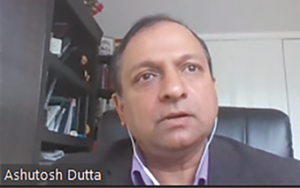
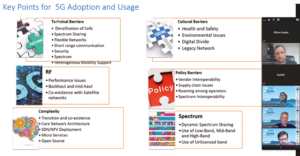
In the keynote following this session, Ashutosh Dutta, IEEE Communications Society Distinguished Lecturer & Co-Chair for IEEE Future Initiative, presented key points to be considered for secure adoption and usage of 5G.


Ashutosh Dutta, IEEE Communications Society Distinguished Lecturer & Co-Chair for IEEE Future Initiative

Session 3 discussed ‘Security Beyond 5G Networks and Services’. It included presentations on ‘Trustworthy Networking Beyond 5G’and ‘Cloud-Scale SDN Network Security in TeraFlow’.

Session 4 finally explored ‘Security Enablers for Beyond 5G Networks and Services’. The presentations covered topics ranging from ‘Machine Learning Applied to 5G Network Cyber Range’, ‘Security and Trust in NetApp Deployment and Operation’, ‘5G Embedded Trust, and ‘Practical Autonomous Cyberhealth for Resilient Micro/Small/Medium-Sized Enterprises’.

The FAST workshop gave an excellent overview on the status of research on automated and intelligent security in 5G and highlighted the challenges on the road towards 6G.


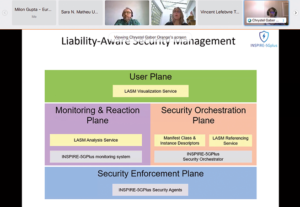
Online presentation at the FAST workshop ‘From 5G to 6G Automated and Intelligent SecuriTy’

Smart Networks and Services JU

In a workshop on the final day of the event (11th June 2021), the objectives and structure of the new European Joint Undertaking (JU) on Smart Networks and Services (SNS) were presented. The envisaged budget volume of the SNS JU is 900 million euro, according to a statement published on the 5G-IA website.

The goal of the SNS JU partnership will be to define and implement the research, innovation and deployment roadmaps that will enable Europe to take a leading role in the creation of the next generation of smart network technologies and services, also known as 6G.

The SNS JU partnership will focus on facilitating the full digitization of European society including vertical industries and public administration services. The 6G SNS solutions will be designed and implemented in such a way that European values like security and privacy are safeguarded, and that European technological sovereignty is further strengthened. The SNS Partnership targets to have a perceptible positive impact on the quality of life of European citizens and a noticeable boost in the European data economy by 2030.

Further information

Joint EuCNC & 6G Summit website – https://www.eucnc.eu

FAST workshop page – https://www.eucnc.eu/workshops/workshop-8/

SNS Partnership – https://5g-ia.eu/sns-horizon-europe

6G

Demonstration of 5G end-to-end validation platform

Final 5G EVE webinar

Milon Gupta
Eurescom

In the final 5G EVE webinar on 26th May 2021, the project consortium presented the major achievements in the development and use of the 5G EVE validation platform to an audience of 60 participants. As a highlight, the 5G EVE team demonstrated live the multi-site capabilities of the platform.

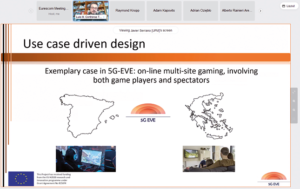
In addition, experts from the consortium presented new platform features like, for example, performance diagnostics, and demonstrated the 5G EVE gaming use case as an illustration of the multi-site capabilities of the 5G EVE platform.

In a short training session in the last part of the webinar, experts from the four 5G EVE sites shared practical knowledge on platform usage, which will be useful for the utilization of the platform beyond the duration of the project.

The webinar was particularly aimed at current and future 5G EVE platform users from 5G PPP use case projects and innovative SMEs, who would like to test and validate their 5G solutions in the most effective way.

Further information
Slides and videos of the presentations are available on the webinar page – https://www.5g-eve.eu/event/final-5g-eve-webinar-validation-platform-achievements-and-multi-site-use-case-deployment/

Presentation of the 5G EVE multi-site gaming use case by Luis Contreras from Telefonica


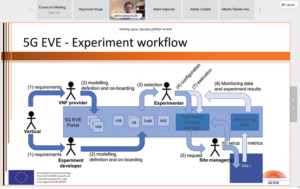
5G EVE experiment work flow for vertical multi-site use cases, presented by Jaime Garcia-Reinoso, University Carlos III de Madrid


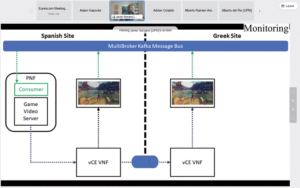
Demonstration of the 5G EVE multi-site gaming use by Javier Serrano from UPM


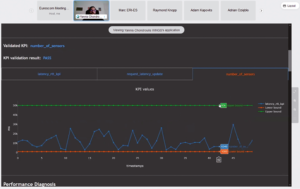
Demo of the 5G EVE performance diagnosis for vertical use cases by Yannis Chondroulis from Wings ICT

5G

5G and Beyond

5G World Forum explored future networks

Milon Gupta
Eurescom

The 2020 edition of the IEEE 5G World Forum was originally scheduled to take place in Bangalore, India in September. Due to the COVID-19 pandemic, the organisers had to turn the event into an online conference. The focus of the third 5G World Forum was on ‘5G and Beyond: A Comprehensive Look at Future Networks’. It particularly aimed to explore how to nurture and cultivate 5G technologies and applications for the benefit of society.

A plethora of sessions and presentations

The pre-recorded sessions and presentations of the three-day programme were accessible to participants from 10th September to 2nd November. The programme offered participants a rich choice: There were 16 plenary keynotes by speakers from major companies, institutions and universities like the US Federal Communications Commission, China Mobile, Qualcomm, Airbus, ETSI and more. The keynote speakers covered a wide range of topics, from 5G deployment and application to concepts for 6G.

In addition to the keynotes, there were technical paper tracks, workshops, forums and panels, 5G topical/vertical tracks, tutorials, demonstrations, and patron exhibits. Unlike an in-person event, this online conference offered participants the opportunity to attend all the sessions they were interested in.

It is almost impossible to provide a representative account of the numerous sessions and presentations. Thus, the selection of two exemplary sessions below is highly subjective – it is based on Eurescom’s involvement in two projects that contributed to the selected sessions, 5G-DRIVE and 5G EVE.

Worldwide 5G industry fora session

5G-DRIVE is a Horizon 2020 project dedicated to EU-China collaboration in the area of 5G testing and validation. The project coordinator from Eurescom was invited to participate in a high-level panel on worldwide 5G industry fora. The topic of the panel session was “5G Trends and Collaborations: Regional Visions, Verticals and Inter-Regional Cooperation Activities”. The first panel session focused on Asia and Europe. It was moderated by IREST chairman Jean-Pierre Bienaimé and brought together eight panelists from Europe and Asia representing industry, research, and standardisation.


Panel moderator Jean-Pierre Bienaimé and some of the panelists

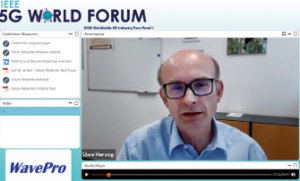
Among the panelists was 5G-DRIVE coordinator Uwe Herzog from Eurescom. In his statement, he provided some background information on the European-Chinese 5G research collaboration between 5G-DRIVE and its Chinese twin project. In answering the moderator’s question on the effectiveness of the European-Chinese collaboration, he emphasized that despite the organizational challenges of coordinating 5G trial activities between two projects on different continents and in different commercial contexts, the joint trial activities have progressed well and yielded a fruitful exchange and interesting results.


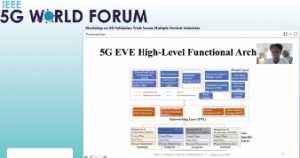
Winnie Nakimuli from UC3M presenting the 5G EVE paper

In a separate presentation, Uwe Herzog provided a more detailed overview on the joint EU-China trial activities of 5G-DRIVE and the Chinese twin project in the areas of enhanced Mobile Broadband (eMBB) and Vehicular to everything (V2X).

Overall, the first industry fora panel presented an excellent overview on the manifold activities towards 5G development, testing and deployment in Europe and Asia.


5G-DRIVE coordinator Uwe Herzog from Eurescom talking about the 5G-DRIVE project in the Industry Fora Panel

Validation trials workshop

5G EVE contributed a paper to the workshop on “5G Validation Trials across Multiple Vertical Industries” (WS2). The online workshop aimed at providing a forum for industry and academia to disseminate new results on 5G trials in vertical industries as well as share knowledge on related new 5G business developments. It brought together six researchers from industry and academia, who presented their papers.

Among them was Winnie Nakimuli from the University Carlos III of Madrid (UC3M), who presented the 5G EVE paper on “Automatic deployment, execution and analysis of 5G experiments using the 5G EVE platform” (Paper No. 1570654444).

The rationale underlying the workshop was the essential role of validation trials for commercial 5G rollout, to test 5G features of novel services and applications in complex deployed environments. Such validation trials, like the ones performed via the 5G EVE platform, allow identifying and addressing issues related to coverage, interoperability, compatibility, and service provisioning. This is crucial for ensuring that 5G meets the requirements of various vertical sectors.

Further information

  • Programme of IEEE 5G World Forum – https://ieee-wf-5g.org/program/
  • Worldwide 5G Industry Fora Session 2020 – https://ieee-wf-5g.org/worldwide-industry-fora-session-2020/
  • 5G Validation Trials Workshop – https://ieee-wf-5g.org/workshop-on-5g-validation-trials-across-multiple-vertical-industries/

Just transition to a sustainable Europe

European Research and Innovation Days

Milon Gupta
Eurescom

The European Research and Innovation Days are the European Commission’s annual flagship event for research and innovation. This year, due to the COVID-19 pandemic, it was held as an interactive online event from 22nd to 24th September 2020. The dominating topic was the European Green Deal.

 
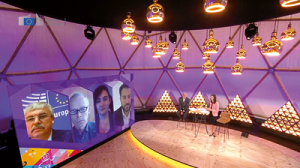
Panel session with Commissioner Mariya Gabriel (right)

The three-day Commission event combined high-level speeches and panels with topic-specific information aimed at potential project proposers. The large choice of sessions included in addition to the high-level plenary 10 information and interaction tracks called ‘Hubs’ on the following central areas in EU research and innovation: Policy, Green Deal, Digital, Horizon Europe, Missions, Smart Implementation & Synergies, International Cooperation, European Innovation Council, European Institute of Innovation & Technology, and European Research Council.

Green Deal plenary

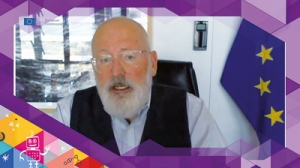
In the day-one plenary on “European Green Deal & Just Transition”, Frans Timmermans, Executive Vice President of the European Commission, presented the EU vision of a sustainable Europe, which decarbonises its economy and reaches zero greenhouse gas emissions by 2050. Mr Timmermans stressed that this transition has to happen in a socially inclusive way, where no one is left behind.


Executive Vice President Frans Timmermans presenting the EC vision of a sustainable Europe and a just transition

New European Research Area

In the next plenary, a high-level panel of speakers, including Commissioner Mariya Gabriel, discussed the steps towards a new European Research Area (ERA). The panellists talked about the main novelties of the ERA communication including its contribution to build an excellent European R&I system for the benefit of all, and its new approach towards a wide outreach engaging all levels, including Member States, regions and citizens in this endeavour.

Green Deal Call Info Day

On the second day of the event, several information days on open Horizon 2020 calls took place, among them the information day for the Green Deal call. John Bell, Director Healthy Planet at the EC’s DG Research & Innovation, explained the goals and expected outcomes of the Green Deal call. It has a volume of around a billion euro spread across 8 Green Deal work streams. The EC expects from Green Deal projects a short-term and medium-term impact towards the achievement of the EC’s CO2 emission reduction goals.

Mr Bell pointed out that all solutions developed in Green Deal projects need to be scalable and socially acceptable. In view of the coming Horizon Europe programme, he said that 35{b28ae05319d94bff0b4d65c5a9f4524dd588360f05c61ef440e1608e0a1c4144} of Horizon Europe is envisaged to be for Green Deal related projects.


John Bell, Director Healthy Planet at the EC’s DG Research & Innovation

Conclusion

The event featured many more facets of the EU’s vibrant research and innovation ecosystem, including the contribution of women in technology as well as the way research and innovation will help in shaping the post-COVID-19 world.

Beyond sharing information, the event also enabled the interaction with and between participants via proposal pitches at online brokerage events and meetings in virtual chat rooms. Although the virtual format could not replace in-person meetings, it managed to facilitate interaction. Even in a post-COVID-19 world, when large-scale meetings are possible again, it might be the more sustainable option to keep the virtual format for the European Research and Innovation Days.

Further information

European Research and Innovation Days website – https://research-innovation-days.ec.europa.eu/

Public premiere of 5G EVE Portal

Live demo at webinar


Manuel Lorenzo from Ericsson Spain


Giada Landi from Nextworks

In a webinar on 27 February 2020, the 5G EVE Portal was for the first time demonstrated live to the interested public. 47 participants, mostly from vertical use-case (ICT-19) projects of the 5G Infrastructure Public Private Partnership (5G PPP), attended the live demo of the 5G EVE portal and validation framework.

The webinar was moderated by Mauro Boldi from TIM, the coordinator of 5G EVE. Originally, the 5G EVE Portal was planned to be presented at MWC 2020 in Barcelona. Due to the cancellation of the event, the 5G EVE team had decided to present the demo online instead.

After the welcome and overview by Mauro Boldi, Manuel Lorenzo from Ericsson Spain, technical manager of 5G EVE, briefly explained the roadmap of the 5G EVE validation platform for 2020 and 2021. The roadmap involves three major activity areas: (i) platform validation, (ii) cooperation with ICT-19 projects, and (iii) continued platform development.


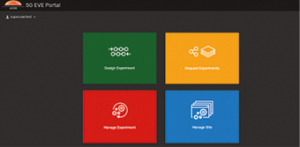
Overview on how to use the 5G EVE portal


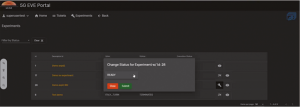
Demonstration on how to change the status of an experiment

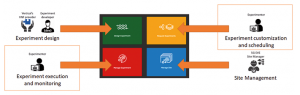
The demo was presented by Giada Landi from Nextworks, who is deputy technical manager of 5G EVE. Before going into the actual live demo, she gave an introduction to the 5G EVE experimentation workflow, which consists of four phases: (i) test design, (ii) test preparation, (iii) test execution and monitoring, and (iv) test performance evaluation and analysis. She went on to explain the key roles in the experimentation workflow:

  • Vertical: actor with the knowledge of the service to be tested, including SLAs and service components.
  • Verticals’ VNF (Virtualized Network Function) provider: actor who provides the VNF packages for the vertical applications.
  • Experiment developer: actor responsible for specifying the blueprints associated to an experiment, as well as the associated NFV network services descriptors. This user has the knowledge about the 5G EVE infrastructure and expertise about NFV network service modelling.
  • Experimenter: actor responsible for the request of an experiment and the assessment of its results; defines the characteristics of an experiment starting from its blueprint, requests the deployment of related virtual environment and experiment execution and analyses results and KPIs.
  • Site manager: system and infrastructure administrator for a 5G EVE site.

In addition, Giada Landi explained the basic concepts and terminology, including Experiment Blueprint, Network Service Descriptor, and Experiment Descriptor. After the introduction to the 5G EVE experimentation workflow, she logged into the portal and went live through the steps of setting up an experiment on the 5G EVE Portal.


Graphical user interface of the 5G EVE portal

About 5G EVE

5G EVE, the ‘5G European Validation platform for Extensive trials’, is a European infrastructure research project within phase 3 of the 5G Infrastructure Public-Private Partnership (5G PPP). The project ambition is to be instrumental towards the pervasive roll-out of 5G end-to-end networks in Europe. 5G EVE started on 1st July 2018 and runs for 36 months. The 15.7 million euro project is coordinated by TIM and is co-funded by the European Commission under the EU’s Horizon 2020 programme.

Further information:
Video recording of the 5G EVE Portal demo – https://youtu.be/sv0CJHX12vA
5G EVE website – https://www.5g-eve.eu

Everything you always wanted to know about 5G network slicing

The SliceNet project outcomes webinar series

Over a period of four months, from February to May 2020, Horizon 2020 project SliceNet organised a series of seven webinars to present its outcomes and achievements in the area of 5G network slicing. The webinars proved to be quite popular, given their technical nature – they constantly attracted between 30 and 60 participants. Moreover, the questions asked in the Q&A part of each webinar showed the substantial interest of participants in 5G network slicing and the results of SliceNet. The good news for those who missed the webinars is that they were all recorded.

Webinar 1:
5G Multi-Domain Slice Control Plane

In the first webinar, Ciriaco Angelo from Ericsson R&D presented requirements and challenges of the 5G multi-domain slice control plane, the SliceNet Approach to design and prototyping, technical achievements and innovations in the area of slicing, and applications in vertical use cases.

Video recording – https://youtu.be/plyopOq437Y

Webinar 2:
Cognitive, Service-Level QoE Management

In this webinar, Kenneth Nagin from IBM Israel explained how SliceNet’s Cognition Sub-Plane enables 5G network slice management using machine learning to identify problems and policy driven remedial actuations to fix problems. He described the role played by the sub-plane addressing slice management within the three SliceNet use cases, namely Smart Grid, eHealth, and Smart City. The webinar presented the objectives, requirements and challenges for the cognitive sub-plane, the technical approaches for design and prototyping as well as technical achievements in QoE management. A summary of SliceNet innovations in the area of cognitive QoE management concluded the presentation.

Video recording – https://youtu.be/mMTzCxLL0-c

Webinar 3:
5G Multi-domain Slice Management

This webinar was particularly aimed at developers in vertical industries and those interested in the design of 5G applications enabled by 5G multi-domain slice management. Thuy Truong from DellEMC started by giving an introduction to 5G multi-domain slice management, and then continued to discuss the requirements and challenges of 5G multi-domain slice management. She went on to explain the technical approach for design and prototyping and then discussed vertical applications and QoE management innovations.

Video recording – https://youtu.be/skyQds_QXAM

Webinar 4:
SliceNet System Architecture

This webinar was aimed at developers and designers both in vertical industries and research interested in SliceNet’s 5G system architecture for multi-domain slicing. Marius Iordache from Orange Romania started by giving an introduction to the SliceNet System Architecture, and then discussed the requirements and challenges, particularly the vertical requirements that had to be identified and considered in the architecture. He went on to explain architecture design and functional decomposition as well as SliceNet’s end-to-end slicing friendly reference architecture. He concluded by presenting selected vertical use cases.

Video recording – https://youtu.be/CmDVhT73tSo

Webinar 5:
Cross-Plane Orchestration and Use Cases Prototyping

This webinar was aimed at developers and designers both in vertical industries and research, interested in 5G system architecture and orchestration. Jose Cabaca from Altice Labs discussed, how the SliceNet definition of Business Roles relateds to the definition of Business Roles by ITU-T. He went on to explain the SliceNet Architecture and Orchestration Plane, including particular challenges and requirements. He then focused on the DSP end-to-end service and slice orchestration as well as on the NSP network orchestration. In the last part of the webinar he explained orchestration journeys and provided a summary of innovations.

Video recording – https://youtu.be/deKSGoHMxJ0

Webinar 6:
System Integration and Demonstration

This webinar was aimed at developers and designers both in vertical industries and research, interested in 5G system integration and frameworks. Georgios Tsiouris from OTE presented the system integration and demonstration achievements of SliceNet. After discussing requirements and challenges, he explained SliceNet’s technical approach to system integration and the SliceNet framework validation. He concluded by presenting selected use-case demonstrations.

Video recording – https://youtu.be/bgJWevMbYKQ

Webinar 7:
5G Integrated Multi Domain Slicing Friendly Infrastructure

This webinar was aimed at developers and designers both in vertical industries and research, interested in 5G slicing infrastructure. Navid Nikaein from EURECOM explained SliceNet’s technical approach for design and prototyping of a 5G integrated multi-domain slicing-friendly infrastructure, highlighting the technical achievements and major innovations. He concluded by showing selected vertical applications.

Video recording – https://youtu.be/IMTMX-my3Lk

Further information
SliceNet project website – https://slicenet.eu

5G driven efficiency boost for manufacturing – IEEE 5G World Forum in Dresden

IEEE 5G World Forum Dresden


Uwe Herzog                                                                   Milon Gupta
Eurescom                                                                       Eurescom
herzog(at)eurescom.eu                                              gupta(at)eurescom.eu

The second edition of the IEEE 5G World ­Forum, the flagship event of the IEEE Future Networks Initiative, took place in Dresden, Germany from 29th September to 2nd October. The event was held in conjunction with the 4th IEEE 5G Summit and consisted of a conference, several workshops, and an exhibition. More than 1,000 international participants came to the International Congress Center Dresden to discuss the future of 5G.


Prof. Henning Schulzrinne

Cautionary messages at the opening

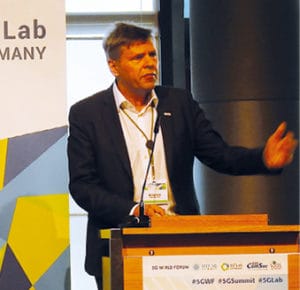
In the opening plenary, Prof. Henning Schulzrinne from Columbia University seemed rather sceptical about the economic success of 5G – at least as far as telcos and equipment manufacturers are concerned. He rather expects that 5G could lead to industry consolidation.

Dr. Thyaga Nandagopal from the US National Science Foundation took a similarly sceptical line. He tried to calm down the hype about 5G that some say might change everyone’s life. Dr. Nandagopal warned not to expect too much. That said, he was confident that there would be many interesting new applications enabled by higher bandwidth, lower latency and higher device density.

Dr. Michael Bolle, Chief Digital Officer and Chief Technology Officer at Bosch, was more upbeat about 5G. In the area of mobility, he considers 5G to be an answer to the requirements of V2X, e. g. for platooning or tele-operated driving.

In the manufacturing domain, Dr. Bolle sees the high potential of 5G for improving efficiency and cost of production – especially in Bosch’s own 180 plants worldwide. This will be needed to respond to the trend of mass customisation, which requires high flexibility and wireless connectivity as well as flexible device positioning with wireless charging. Especially for safety-critical functions he considers 5G to be better than WiFi.

In terms of 5G deployment, Bosch clearly favours closed and private networks connected to the Bosch factories, either autonomously or provided by telcos and device manufacturers. Dr. Bolle stressed that for Bosch, security and avoiding attacks is crucial.


Dr. Michael Bolle

More insights from the conference

In the Worldwide 5G Industry Fora Session, Heinz Bernold from Boston Consulting Group highlighted the operators’ increased network costs for 5G; he estimated a 60{b28ae05319d94bff0b4d65c5a9f4524dd588360f05c61ef440e1608e0a1c4144} increase.

In the plenary session on the second day, Dr. Hannes Ametsreiter from Vodafone Germany highlighted the importance of 5G’s low latency for applications like controlling a drone or remotely controlling building cranes and other equipment.

As an application example for factories he mentioned a recently completed car production plant in Aachen, which is 5G-enabled. This gives high flexibility to the production process, for example by providing almost real-time detailed information on the status of the production process. This information can be stored in a blockchain and monitored any time.

Peter Riedel, President and Chief Operating Officer of Rohde & Schwarz, emphasised that 5G can help in automation and save infrastructure costs. He said Rohde & Schwarz has seven-digit infrastructure costs every year. Apart from cost-savings, he stressed the importance of security, reliability and low latency as well as high relia­bility enabled by 5G.

Further information: IEEE 5G World Forum website – https://ieee-wf-5g.org

From 5G experiments to business validation

5G-Trials workshop at IEEE 5G World Forum


Uwe Herzog                                                                   Tao Chen
Eurescom                                                                       VTT
herzog(at)eurescom.eu                                               tao.chen(at)vtt.fi

On 1st October 2019, the “2nd Workshop on 5G-Trials – From 5G Experiments to Business Validation” took place in Dresden. It was part of the IEEE 5G World Forum in Dresden from 30th September to 2nd October 2019. The workshop was jointly organised by the 5G PPP projects 5G-DRIVE, 5G EVE, 5G-VINNI, 5GENESIS, and SLICENET.


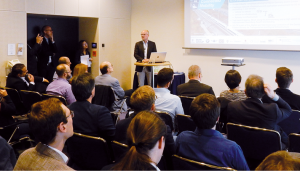
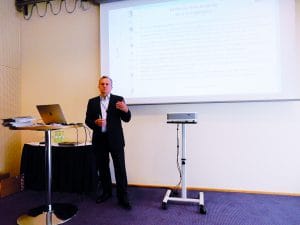
Keynote speaker Michael Meyer from Ericsson

At the current stage of 5G evolution, the design phase has been successfully completed, the first set of standards has been released, and the commercial rollout has started. In this context, a large number of 5G trials are currently being conducted around the globe. According to IDATE DigiWorld statistics from June 2019, 153 5G trials are currently taking place in the 28 EU Member States. The 5G-Trials workshop provided a forum for industry and academics to disseminate new findings on 5G trials and new business development.

The workshop was sponsored by five 5G PPP projects. They included, among others, the three projects that are currently building experimental 5G infrastructures, which will be offered for experimentation to vertical industries for testing innovative 5G applications. From that perspective the organisers are well connected in the 5G community and were successful in distributing the call for papers for this workshop. With 14 paper submissions received, this workshop was ranked number 3 among all workshops. Due to the high quality of papers, 9 out of the 14 papers were accepted. The paper presentations together with two invited keynote speeches and two panel discussions filled a long and interesting day for the about 40-50 workshop attendees.

5G trials in Europe

In the welcome talk, an overview was given of 5G trialling activities in Europe and showed some statistics e.g. in terms of trials per country, spectrum usage, the participation by vertical sectors in 5G trialling activities and the size of larger trials and first 5G roll-outs around the globe. Media and Entertainment is the sector in which most 5G trials are currently performed, followed by Transport and Automotive.

In the first keynote speech, Michael Meyer from Ericsson gave his view on “Experiencing 5G in early trials”. He said that 5G is being propelled by three areas – massive machine-type communications, critical machine-type communications, and Enhanced Mobile Broadband, where the use cases will be diverse, ranging from Haptic Healthcare to driverless buses and fibre-equivalent residential access. Ericsson’s 5G radio and core testbeds have evolved to include an increasing number of 5G features. Trials are being performed in both below 6 GHz but also in mm-wave bands. In the speaker’s view, 5G industry trials are important to explore the digital transformation of different industries, and to demonstrate the value of 5G, which he explained by using examples from the mining industry, connected mobility, and connected adaptive production.

In the first paper session, three papers with results related to the 5G PPP trial infrastructure projects were presented. These projects build 5G infrastructures for the large-scale trials carried out by other 5G PPP projects. The first paper, presented by Giada Landi from Nextworks, introduced the experimental architecture developed in 5G EVE, and explained the experimental workflow to be used by other projects. The next paper, presented by Anastasius Gavras from Eurescom, introduced the trial infrastructure of the 5G-VINNI project. 5G-VINNI aims to provide infrastructure as a service to other projects. He explained the conceptual architecture, technical areas covered by the project, and the testing capability of the facility. The third paper was also from 5G-VINNI, but it focused on the business aspect of the project. It explained the strengths, weaknesses, opportunities and threats (SWOT) analysis of the 5G-VINNI facility.

Use of 5G by verticals

In the second keynote, Panagiotis Demestichas from University of Piraeus presented the 5G Pan-European Trials Roadmap which is being prepared by the 5G Infrastructure Association’s 5G Trials Working Group. The presentation provided ample details of ongoing and planned 5G trialling activities in Europe. He also informed the audience about an informative brochure on selected 5G trials and pilots being undertaken by 5G PPP projects. The brochure can be downloaded from the 5G PPP website.

The second paper session was related to the use of 5G technologies for verticals. Two papers were presented. The first paper, presented by Mikko Uusitalo from Nokia, introduced how ultra-reliable and low-latency communication (URLLC) services can be applied to the automation of harbours. The paper investigated, if the latency of 5G networks can satisfy the remote-control needs of crane operation. The second paper, presented by Mark Roddy from Cork Institute of Technology, introduced the network slicing results from the SliceNet project. It showed how the combination of network slicing and edge computing can support the emergency use case of stroke patients in an ambulance.

The third paper session focused on the evaluation of three 5G use cases. The first paper examined 5G solutions for the media and entertainment industry. Presented by Giuseppe Caruso from Engineering Ingegneria Informatica, the paper introduced three 5G business scenarios in the media industry. It explained also how 5G may affect business relationships of stakeholders in the media industry. The second paper, presented by Eleanor Davies from Lancaster University, presented the performance measurement of a fixed wireless broadband system based on TV white space and millimetre wave in rural areas of UK. It showed that TV white space has potential for stable broadband services in rural areas, while the millimeter wave has limitations due to line-of-sight constraints in irregular terrain. The third paper dealt with the 5G tourism use cases. Konstantinos Katsaros from Digital Catapult presented how 5G technologies can support an augmented reality tour of ancient Roman baths. The 5G key technologies used in the test include multi-access edge computing (MEC) for remote rendering, network slicing, and software defined networking (SDN).


Keynote speaker Panagiotis Demestichas from University of Piraeus


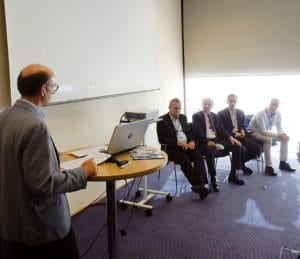
Panellists of the first panel session on Results from 5G Trials, Verticals and Business
Opportunities (from left): Panagiotis Demestichas, University of Piraeus; Jean-Pierre Bienaime,
IREST; Mikko Uusitalo, Nokia; and Michael Meyer, Ericsson.

Panel discussion on 5G trials

Two interesting panel discussions followed the paper sessions. The first one, moderated by Uwe Herzog, focused on results from 5G trials, verticals and business opportunities. The panellists included Dr. Michael Meyer from Ericsson, Dr. Mikko Uusitalo from Nokia, Prof. Panagiotis Demestichas from University of Piraeus, and Mr. Jean-Pierre Bienaime from IREST. The panellists discussed the main conclusions from recent 5G trials, which vertical sectors are the most challenging ones for introducing 5G technologies, and which verticals will be the first to adopt 5G services.

The second panel, moderated by Anastasius Gavras, focused on the challenges for further trialling and beyond 5G research. The panellists included Prof. Riku Jäntti from Aalto University, Prof. Slawomir Kuklinski from Orange, Dr. Ville Miemelä from Unviersity of Oulu, and Dr. Maria Guta from ESA. The panellists shared their opinions on what type of trials are still needed for 5G, what type of experimental infrastructures are needed to support beyond-5G research, and how the 5G infrastructure will be evolved for future services.

Further information

  • Workshop website –
    https://ieee-wf-5g.org/workshop-2nd-workshop-on-5g-trials-from-5g-experiments-to-business-validation/
  • 5G PPP brochure “Trials & Pilots” –
    https://5g-ppp.eu/wp-content/uploads/2019/09/5GInfraPPP_10TPs_Brochure_FINAL_low_single­pages.pdf
  • Previous
  • 1
  • 2

5Copyright © 2025 by Eurescom

 
  • Corporate Information
  • Data Protection Declaration
  • Terms of Use
  • Corporate Information
  • Data Protection Declaration
  • Terms of Use