


Gergely Biczok Mustafa Ozger
AITIA & KTH Royal Institute of Technology
Budapest Univ. of Technology and Economics


Cicek Cavdar Dominic Schupke
KTH Royal Institute of Technology Airbus
Introduction
The CELTIC-NEXT project 6G for Connected Sky (6G-SKY), brought together 17 partners from Austria, Germany, Hungary, and Sweden between 2022 and 2025. The project aimed to create a holistic framework that integrates terrestrial networks, non-terrestrial networks (NTN), and the airspace domain into one seamless system for the coming 6G era. 
The ambition was to ensure that aircraft, drones, and high-altitude platforms can communicate safely, reliably, and sustainably. Applications range from urban air mobility services and logistics to satellite-supported broadband/IoT communications in remote areas.
Architecture and Use Cases
One of the key outcomes of 6G-SKY is a holistic architecture for combining airspace and NTN with terrestrial networks . This architecture supports multiple use case segments, including commercial aviation, rural connectivity, satellite backhaul, and public safety.
The project identified regulatory and spectrum challenges for low-altitude platforms, developed business models including highlighting selected value chains, and examined sustainability aspects, such as the use of non-fossil propulsion systems. In parallel, 6G-SKY partners provided contributions to 3GPP, ensuring that European perspectives are represented in standardisation.
Mobility Management
Keeping drones connected to mobile networks is not as easy as keeping a phone connected. Unlike people on the ground, drones fly at different heights and often “see” many base stations at once. This creates a problem: the drone keeps switching its connection from one base station to another, even when it is not really needed. These constant changes – called handovers – can interrupt the connection and slow down data transfer.
The 6G-SKY project tackled this challenge with two different solutions :
› A smarter rule-based method (“Robust Service Availability Optimization”): This method looks at how much data the drone still has to send (its buffer). If the buffer is nearly empty, the drone can wait before switching to a new base station, avoiding unnecessary handovers. If the buffer is full, the system makes sure the drone quickly connects to the strongest base station, so the data is sent without delay.
› A learning-based method (“Deep Learning”): Instead of using fixed rules, this approach lets the system learn from experience. By trying different options during test flights, the system figures out when a handover is truly necessary and when it is better to stay connected. Over time, it becomes very good at balancing service quality and stability.
Tests showed that both approaches made a big difference. They reduced unnecessary handovers by more than half and improved the overall reliability of the connection, which is especially important for drones that need to send live video or critical sensor data.
Explainable Artificial Intelligence (AI)
Learning-based methods are powerful, but they often act like a “black box” – they make decisions, yet people cannot easily see why. In safety-critical areas like aviation, this lack of transparency is a serious challenge.
To address this, 6G-SKY introduced explainable AI. The idea is simple: whenever the system decides that a drone should change base stations, it also explains why. For example, it might say: “The new base station has a stronger signal, and the drone’s buffer is full, so switching now avoids delays.”
This is achieved through a tool that checks how much each factor – such as signal strength, position, or remaining data in the buffer – influenced the decision. On top of that, the system can turn these numbers into clear sentences, so network operators can understand the reasoning without needing to be data scientists.
In real test flights, this approach not only reduced unnecessary handovers, but also gave operators confidence that the system was making the right choices. In other words, it made the AI not only smart but also trustworthy.
Cybersecurity for Sky
6G-SKY also analysed threats in the sky. In future 6G networks, drones and high-altitude platforms will act as part of the communication infrastructure. This raises serious safety and security concerns. Coordinating crewed and uncrewed aircraft will become more difficult, and having a real-time overview of the airspace, including non-cooperative drones, will be essential to avoid accidents.
6G-SKY suggests that traffic management providers combine information from ground-based detection systems with data received directly from cooperative drones. Today, these systems often rely on signals that are easy to fake, which opens the door to spoofing attacks. To keep the skies safe, stronger safeguards are needed; either by improving existing technologies with integrity checks or by developing new, more resilient methods.
Ultimately, because digital and physical risks are tightly linked, safety and cybersecurity must be designed hand in hand.
Combined with explainable AI for decision transparency, these measures contribute to more trustworthy and resilient aerial communication systems.
Demonstrations
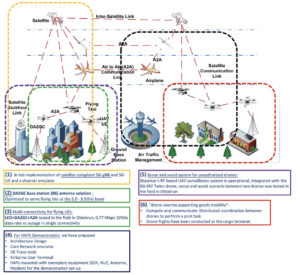
The consortium put its concepts to the test in a series of demonstrations, illustrated in Figure 1, which shows both the overall architecture and the different trials carried out:
› (1) Lab emulations to assess link benchmarks and validate connectivity in controlled conditions.
› (2) Innovative antenna design prototypes for direct air-to-ground communication, with lab tests at 7 GHz, simulations, and performance evaluations of new antenna concepts.
› (3) Multi-technology Uncrewed Aerial Vehicle (UAV) platforms combining Wi-Fi mesh, 5G, and satellite links.
› (4) High-altitude platform networking trials for future NTN integration.
› (5) Autonomous sense-and-avoid functions for safe mixed-use airspace.
› (6) Drone swarms inspecting container stacks with cloud offloading and mesh networking.
These demonstrations confirmed that the proposed architecture and algorithms are ready to support real-world operations.
Conclusion
6G-SKY has delivered a blueprint for the 6G-connected European sky and beyond. By combining terrestrial, aerial, and satellite networks, advancing mobility management, and introducing explainable AI, the project has provided both technological and regulatory guidance for 6G-enabled airspace integration.
These results not only push forward standardisation in 3GPP but also prepare the ground for sustainable business models and safe large-scale deployment of UAV and aerial platforms.