
5G-based collective intelligence for health crisis management


Mapi Aranda Sánchez Elçin Ozgun
Project Manager Officer, Ingubu Business Analyst, ETIYA
Motivation
The AICom4Health project (2022–2025) grew out of the COVID 19 pandemic and the need for smarter health crisis management. Public health authorities struggled to monitor people’s health status and to react quickly when contagion surged. AICom4Health addresses this problem by combining AI, Internet of Things (IoT) devices, edge computing and 5G network slicing. The goal is to monitor individuals and crowds in real time, detect early signs of health threats and provide fast, privacy friendly intervention. The project aims to deliver better healthcare access in smart cities by using sensors and video analytics to observe air quality, mask wearing, social distancing and symptoms, and to send relevant information to health teams instantaneously.
Platform concept and architecture
The AICom4Health platform integrates multiple technologies:
› 5G network slicing and virtualization – separate slices carry traffic for air-quality sensors, surveillance cameras and city health forecasting; network resources can be dynamically allocated to guarantee high reliability and low latency.
› Edge and cloud computing – data from cameras and IoT devices are processed close to the users to reduce latency, while cloud resources provide additional computational capacity.
›AI and machine learning – deep learning, natural language processing (NLP), explainable AI and knowledge graphs enable the detection of abnormal situations and the forecasting of health trends.
› Privacy-friendly AI – decentralised and federated learning allow models to be trained without sharing sensitive personal data. This framework complies with the EU General Data Protection Regulation (GDPR), ensuring the protection of citizens’ health information.
The figure above illustrates the end-to-end architecture. Multiple use-case slices connect sensors (air-quality IoT devices), video cameras and forecasting modules to the 5G radio access network (RAN), transport and core network. An AI module interfaces with a management and orchestration layer to provide collective intelligence across slices. The architecture is designed to be elastic (resources can grow or shrink dynamically) and resilient (network and computing failures can be absorbed without interrupting critical services).
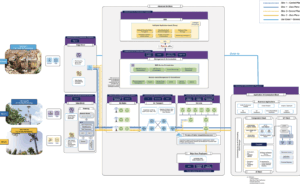
AICom4Health end-to-end architecture
Achievements and innovations
Over its three-year lifetime AICom4Health delivered important innovations:
› Comprehensive health crisis services – The platform provides services that require 5G capabilities such as high bandwidth and ultra-low latency. It continuously monitors individuals and crowds using multivariate analysis (air quality, human density, mask-wearing, temperature and other health indicators).
During pandemic conditions, sensors and cameras detect poor air quality, social distancing violations, mask breaches and symptoms like fever or fatigue; AI algorithms fuse these data and alert health teams in real time.
› Privacy-friendly collective intelligence – A decentralised AI framework enables federated learning for city health monitoring and forecasting. Models are trained locally and aggregated globally, minimizing data transfer and protecting personal privacy. Explainable AI (XAI) and knowledge graphs give regulators and health professionals transparency over AI decisions, improving trust and regulatory compliance
› Dynamic slicing manager – The project designed an application-based slicing orchestrator to provision multiple network slices for different services. This solves the lack of standardised slicing APIs and allows the network to automatically allocate resources to critical applications.
› Integration of data communication and processing – Edge computing and 5G are combined with AI to process data in near real time while preserving network reliability. The platform was tested in lab and real-world environments.
Business and scientific impact – AICom4Health opens new business opportunities by enabling companies to offer services that rely on network slicing, federated learning and AI-based health monitoring. The project produced scientific contributions through publications and real-world evaluations.
Partner contributions and collaboration – AICom4Health is a collaborative effort between Turkish and Spanish companies and research institutions. The consortium unites expertise across IoT device manufacturing, telecom infrastructure, AI software, network slicing orchestration and data analytics.
› IoT & sensing – Partners specialising in hardware and embedded systems integrate air quality sensors, wearables and smart cameras into the platform. In 2024 the team successfully fused human density detection from cameras with air quality measurements and developed warning software to alert authorities about risky situations (netas.com.tr).
› Network and orchestration – Telecom operators provide 5G infrastructure and slicing capabilities; system integrators design the dynamic slice manager to enforce secure, resilient connectivity across slices and support high capacity, low latency data delivery.
› AI and data analytics – Software companies and research groups develop privacy preserving AI models, federated learning frameworks and explainable AI dashboards. These tools enable real time anomaly detection, predictive health forecasting and transparent decision support.
Through this interdisciplinary collaboration the consortium showcases how European SMEs and large enterprises can jointly build a secure, AI powered healthcare platform.
Positioning in the cybersecurity landscape
AICom4Health places cybersecurity at the heart of its design while developing 5G and AI-enabled health solutions. One of the platform’s distinctive features is its use of decentralised federated learning; personal health data are processed on local edge devices and only model updates are shared. This ensures compliance with GDPR and minimises privacy breaches that could arise from collecting data on central servers. Recent research shows that blockchain and AI/ML technologies offer significant potential for real-time breach detection, predictive risk assessment and automated compliance monitoring. AICom4Health’s architecture follows these trends by integrating privacy-preserving data analytics; blockchain-based auditing and verification mechanisms are planned for later stages.
Another critical component of the security approach is the secure use of network slicing. In 5G networks, slicing creates virtual network segments dedicated to different applications so that the slice carrying health data operates in isolation. However, literature indicates that cross-slice attacks can occur due to insufficient isolation, SDN/NFV vulnerabilities and multi-tenant architectures. AICom4Health uses a dynamic slice manager that defines separate security policies for each slice and provides continuous visibility to operators. AI-powered analytics detect anomalies across slices and can adjust resources instantly, preventing data leaks or service disruptions.
At the application level, cybersecurity manifests itself through the intelligent health services delivered by the platform. Air-quality monitoring, crowd analysis and mask detection rely on sensor networks and video analytics; therefore, the secure collection and processing of these data are critical. AICom4Health’s edge computing and 5G infrastructure offer millisecond-level reaction times, allowing suspicious activities or anomalies in the data to be detected quickly and relayed to security teams. Experts emphasise that blockchain-based audit logs and AI-driven intrusion detection systems are effective methods for ensuring the integrity of health data and preventing unauthorised interference. The project aims to raise the security bar in healthcare applications by integrating these technologies.
In summary, AICom4Health is not only a platform for pandemic management; it is also an innovative example that incorporates the cybersecurity measures required by emerging AI technologies. The federated learning frameworks, secure network slicing mechanisms and real-time anomaly detection developed by the project provide a solid security foundation for future health technologies.
Conclusion
AICom4Health has delivered a holistic platform for managing health crises in smart cities. By blending AI, IoT, edge computing and 5G network slicing, it offers real-time monitoring of individuals and crowds, privacy-preserving analytics and dynamic resource orchestration. The project’s innovations—federated learning, explainable AI, dynamic slicing manager and integrated sensor analytics—provide a blueprint for future digital health solutions. Moreover, AICom4Health’s attention to data privacy and secure network slicing positions it well within the cybersecurity theme of the 2nd edition of the 2025 Eurescom’s Message and CELTIC News. As the project concludes, partners aim to commercialize the platform, bringing AI-driven health monitoring and secure 5G connectivity to market.