CELTIC-NEXT Group of Experts are central and instrumental to CELTIC’s success since its inception in 2003. They are at the core of CELTIC’s SRIA, Labelling Evaluations, Projects’ Evaluations, and Reputation. Without them, there would be no CELTIC, CELTIC-PLUS, or CELTIC-NEXT programmes! They are the CELTIC Experts!
Please allow us to offer more insight into their group in CELTIC-NEXT, including their tasks and the impact they have on your projects.
Purpose of the CELTIC-NEXT Group of Experts (GoE)
The Group of Experts (GoE) is responsible for assessing project proposals and participating in CELTIC project reviews. The GoE includes several sub-groups dedicated to specific technical areas. Core group members nominate individuals for the GoE, and an expert presides over each GoE meeting.
Composition of the GoE
The CELTIC-NEXT Core Group has established a permanent CELTIC-NEXT Group of Experts, which has delegated responsibilities and carries out specific tasks. The CELTIC-NEXT Core Group determines the working rules for the CELTIC-NEXT Group of Experts. The number of members and the composition of the CELTIC-NEXT Group of Experts are agreed upon by the CELTIC-NEXT Core Group. The CELTIC-NEXT Core Group may decide to replace a member in the CELTIC-NEXT Group of Experts if such a member becomes an Affiliate to another Participant with a representative in the CELTIC-NEXT Group of Experts, or to a company not resident in Europe, or if the criteria for their membership no longer apply, or to appoint additional members.
Labelling and recommending funding
After evaluation by the CELTIC-NEXT Group of Experts, the CELTIC-NEXT Core Group, in agreement with the involved Public Authorities (PAs), decides whether to grant a label, hereinafter called the “CELTIC-NEXT Label”, to the proposed Project. The CELTIC-NEXT Label confirms that the CELTIC-NEXT Organisation considers the proposed Project aligned with the Programme’s goals and that the applying organisations are eligible to participate as Participants in the Programme. It also confirms that the CELTIC-NEXT Organisation recommends the Project for public funding. The CELTIC-NEXT Project Proposal is the fundamental technical document submitted for funding applications to the respective PAs. The final decision on funding rests with the respective PAs.
Responsibilities of the GoE
The CELTIC-NEXT Group of Experts is a delegated responsibility by the CELTIC-NEXT Core Group for all decisions regarding the selection and monitoring of projects. Unless otherwise determined by the CELTIC-NEXT Core Group, the CELTIC-NEXT Group of Experts carries out the following tasks:
› Developing, updating, and implementing guidelines for the selection and ranking of technical projects.
› Making recommendations on giving the CELTIC-NEXT Label to project proposals and funding outlook by PAs.
› Making recommendations in case of major Project change requests.
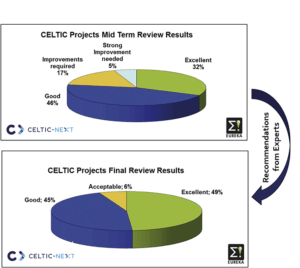
› Participating in mid-term reviews and giving recommendations to achieve better project outcomes (see Figure 1).
› Participating in final reviews, assessing project outcomes and results, and providing further recommendations on further exploitation and potential follow-up projects.
› Advising the CELTIC-NEXT Core Group on all relevant issues.
Figure 1: The positive effect of CELTIC-NEXT’s Experts’ recommendations at mid-term reviews
Operating CELTIC-NEXT as an EUREKA ECP Cluster means that the Office delivers an extensive portfolio of services to our ICT Community and to the EUREKA Network of National Funding and Innovation Agencies.
CELTIC-NEXT’s project calls:
The operation of a CELTIC NEXT call for bottom-up project proposals involves several specific actions:
The first action is to prepare for the call – this means preparing the support for the management of the calls and proposals in terms of Office human resources and system tools, from application preparation to evaluation and labelling. This includes:
Once the systems are prepared, the online or physical events for the call must be orchestrated:
Launch event (online) – how and what to propose
Brokerage event (physical or hybrid) – presentation of public authorities funding, proposers pitches and consortia participants matchmaking
The office staff facilitates these events by offering pitching preparation support before the event and running Consortium Building Sessions in the days following the brokerage and matchmaking.
The office must also allocate a set of qualified experts for the technical assessment of proposals. Should a proposal be labelled, its participants can expect help from the office for the negotiation with the different Public Authorities and coordination of preparation activities up to the project launch.
CELTIC-NEXT’s Flagships
These involve a similar process to the Project construction, but it is initiated in response to the convergence of industry demands and national interests.
CELTIC-NEXT’s Promotion Events
CELTIC-NEXT showcase events are planned, wherever possible, to maximise the exposure and value to the projects and the authorities. These are usually planned in coordination with other major events to ensure good audiences and to control costs.
CELTIC-NEXT’s Support to Projects:
CELTIC-NEXT oversees the running projects to ensure they are working to plan and can deliver the expected results. This is achieved by frequent interactions between the project officer and the project leader and several formal reviews (mid-term, final) during the project life.
Typically, a CELTIC-NEXT project can expect:
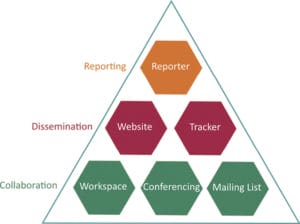
Comprehensive support for reporting, dissemination and collaborative working through the CELTIC-NEXT tool set
Assistance, coaching and monitoring support from the Project officer
Advice and guidance from experts and project officers during the project’s lifecycle (on demand) and in particular at review times (by default)
Simple processes for Project Change Request management, providing flexibility and resiliency to projects when plans need to change
CELTIC-NEXT provides also support for Dissemination activities to the project by inviting them to present at CELTIC-NEXT’s Events, nominating speakers and participations at international events like EUCNC, EGIS,… and highlighting the major achievement of the projects via CELTIC-NEXT’s media channels: LinkedIn, Newsletter, CELTIC News…
Figure 1: CELTIC-NEXT Tools Set
The number of calls per year and regularity
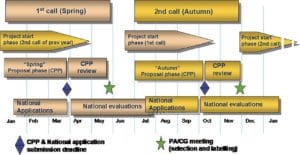
The CELTIC-NEXT community, in consultation with the national authorities have decided that their dynamic domain is best served by having two opportunities in the calendar year to present their project ideas for consideration. Accordingly, two bottom-up calls are organised each year, one in Spring (deadline end of April) and one in Autumn (deadline end of October). For these calls. proposers are free to define their project ambitions according to their ICT research interests and can submit them via our Online Project Portal.
In addition to bottom-up calls, CELTIC offers the opportunity to generate “Flagship” projects/calls at any time if there is an agreed interest. These special interest initiatives can emerge if the industry and PAs share a strong interest in collaborating on a Special Flagship initiative to address a key theme. The CELTIC office will facilitate the flagship by having an agreed submission date, which can differ from the above schedule by specific agreement with the involved PAs, and organising the review and project preparation process around this. These projects are usually in the range of several tens of million Euros for a 3–5-year duration.
Flagship projects are, by their nature, very successful because they are a balance of bottom-up and top-down approaches.
It is important to mention that CELTIC-NEXT operates exclusively thanks to the fees it collects from projects that got labelled and started. This is the only revenue source enabling all the aforementioned services. CELTIC-NEXT Office neither receives public funding from EUREKA Countries nor private money from its Core Group.
CELTIC historic flagship programme started with 100-Gigabit Ethernet Transport Technologies (100 GET), Safe and Secure European Routing (SASER), Secure Networking for a data center cloud in Europe(SENDATE) projects, and Accellerating digital transformation in Europe by Intelligent NETwork automation (AI-NET) flagship. The ramping-up Sustainable Technologies for Advanced Resilient and Energy-Efficient Networks (SUSTAINET) flagship is the successor of those highly successful flagship projects. This is a clear success track record. And they also create highly collaborative communities, as you can take from the AI-NET song ! Those flagship projects were and are still possible because Industry and National Funding Innovation Agencies jointly recognise(d) the absence of adequate funding support in addressing a particular area of the CELTIC-NEXT’s ICT Strategic and Innovation Road Map (SRIA).
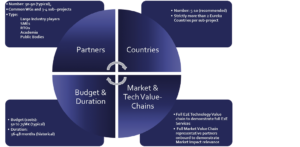
Figure 1: Typical Flagship Characteristics
Preparing and launching a Flagship project requires a concerted approach between a core group of large industry players and a core group of public funding agencies. This small core team delimits the relevant R&D&I area of the flagship, the overall approximative budget envelope to be targeted, and the agenda for developing the project proposal. This is the first preparation phase, consisting of a top-down approach in terms of thematic area and budget envelope. Then, once this is designed, the core industrial consortium will open the flagship proposal to more participants, enabling a considerable number of industry players, SMEs, RTOs, and academics to join the consortium. This is the phase of bottom-up growth within the agreed SRIA area. This is also potentially a growth in terms of budget needs.
Due to the accrued number of participants (up to 100) and subtopics, the Flagship project is then organised around three to four subprojects and an umbrella project that contains all common cross-subproject topics. Another form of maintaining coherence for the horizontal topics is to have a common Work Package with joint tasks across the subprojects (also called vertical projects in the flagship jargon).
Once the horizontal and vertical project proposals are ready, they are submitted to CELTIC-NEXT and the Public Authorities like regular project proposals made in the two-yearly bottom-up calls. They must fulfil the same rules, evaluation criteria, and KPIs.
Flagships are a unique selling point of CELTIC-NEXT in the Eureka Cluster Programme (ECP). There is a strong demand from National Funding & Innovation Agencies to join either in the current topical area of our flagships or in other areas of our SRIA. We aim to reproduce that success in several of them, clearing streams of flagships.
Preparing flagships demands a high intensity of preparation work as they are like mini-programmes. This means that a strategy needs to be put in place to develop them in time and quality. As they target kind of European “funding” market failures, they need also to be well explained to gather the EUREKA national funding agencies support.
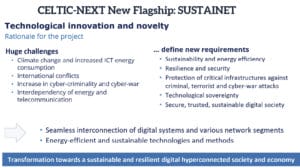
Recall of SUSTAINET high-level description: “In the midst of global crises and geopolitical challenges, Europe is charting its course towards a digital, sustainable future. However, with its share of the global ICT market declining, urgent actions are required to ensure technological sovereignty. This project addresses this multifaceted challenge by focusing on network resilience, energy efficiency, sustainability, high-performing end-to-end networks, and network security.
Achieving seamless interconnection of digital systems, essential for future high-performance communication networks, demands research in ICT hardware and control software. The transition towards a “Digital Society” necessitates increased dependence on ICT for power supply control, emphasising the need for resilient, scalable networking technologies combined with the support of new services such as cognitive and complete context awareness.
Network resilience is paramount in such interconnected networking for critical infrastructures and requires new concepts to ensure communication continuity during errors or disasters. Such networking will also call for secure networks with robust cybersecurity measures to combat evolving threats.
Furthermore, network sustainability is vital for realising a climate-neutral future. Telecommunications networks must prioritise connectivity and serve as platforms for a sustainable society. Operators must adapt to fluctuating renewable energy availability, transitioning from consumers to prosumers in the energy market.
Collaborative R&D efforts are imperative to achieve these objectives and regain technological sovereignty. Government support and industry initiatives must converge to drive innovation in key technologies, fostering industrial cooperation and joint R&D initiatives.
This project proposes a holistic approach, integrating research in frictionless network performance, resilience, security, and sustainability to propel Europe towards a sustainable, technologically sovereign future.”
How does it translate into a tangible project?
Here are some KPIs for SUSTAINET :
8 Countries at labelling time, over 10 now, with some still joining during the ramp-up phase
Over 90 participants of all types, Telcos, Large Industry, SMEs, RTOs, Academia
Over 70 M€ budget,
Over 500 FTEs, split into 3 vertical projects and one umbrella set of horizontal tasks
36 months duration (indicative depending on funding decisions timing)
High expected impact and visibility in standards & markets
On 1st July, Portugal took over the Eureka chairmanship for one year – already for the third time in the 35-year history of Eureka. The motto of the Portuguese Chairmanship is “Innovation for a greener, digital and healthier planet through a collaborative approach”. CELTIC News editor Milon Gupta asked Eureka chairman Miguel Bello Mora, CEO of the Atlantic International Research Centre in Portugal, about priorities and progress of Eureka after the first quarter of the Portuguese Eureka term.
What are the main priorities of the Portuguese Eureka chairmanship?
Miguel Bello Mora: We have five main priorities for the Portuguese Eureka chairmanship:
First, to increase the global outreach of the Eureka Network by promoting collaboration with international organizations with an important innovation component, like the European Space Agency, and via the organization of a series of international events.
Second, to enhance new forms of cooperation for effective RDI programmes by strengthening the relation with the European Union within the new Horizon Europe framework programme for research, development, and innovation.
Third, strengthening the Eureka Network’s positioning by reinforcing the mechanisms for the generation of projects, contributing to the revitalization of the Eureka Clusters Programme.
Fourth, adding value to the Eureka label, with the organisation of Eureka’s Global Innovation Summit 2022 and the Eureka Ministerial Meeting in Portugal in June 2022.
And fifth, to continue the necessary restructuring of the Eureka Secretariat and pursue a healthy financial model for the Eureka Secretariat.
Which role do you see for the Eureka Clusters Programme in the context of the Portuguese priorities?
Miguel Bello Mora: The Portuguese chairmanship is contributing to the revitalization of the Eureka Clusters Programme by implementing the new governance model, ensuring greater compromise from public authorities on the funding of projects, intensifying the participation of industrial key players at the board of Clusters’ governance structures and promoting collaboration and cross-fertilisation between Clusters through the organisation of joint calls.
A joint thematic call is promoted with a topic focused on Space-Ocean-Earth Observation Systems and Space related technologies which would include the promotion of projects linked with the Green Deal in areas like Earth Observation from Space and its combination with Artificial Intelligence.
How would you describe the progress of Eureka in the first months of the Portuguese chairmanship?
Miguel Bello Mora: During the first months of the Eureka Portuguese chairmanship some of the strategic priorities have been implemented, like the collaboration with the European Space Agency, where a Memorandum of Understanding is in preparation, and the first of the international events on “Eureka meets the Atlantic through Space-Ocean-Earth collaborative innovations”. In addition, the final proposal for the Eurostars 3 programme, one of the flagship projects of Eureka, has been completed in August.
What is your vision for Eureka and its programmes beyond the Portuguese chairmanship?
Miguel Bello Mora: Our vision beyond the Portuguese Chairmanship is to have Eureka as a major tool to promote research and innovation, strengthening the bottom-up, open and flexible nature of the network by building on the work done by the previous Chairmanships while following the strategic priorities of the recently approved Eureka Strategic Roadmap for 2021-2027.
Eureka shall promote the dynamism of the economy and European innovation through the recovery period from the crisis associated with the COVID-19 pandemic and should stimulate new opportunities for the development of new products and services in global markets, as well as new international collaborations towards citizens wellbeing and healthy living.
ANI – Agência Nacional de Inovação, SA, is the National Innovation Agency of Portugal. It is owned in equal shares by IAPMEI – the Portuguese Agency for Competitiveness and Innovation under the Ministry of the Economy and Digital Transition – and FCT – the Portuguese Foundation for Science and Technology under the Ministry of Science, Technology and Higher Education. ANI supports technological and business innovation in Portugal, contributing to the consolidation of the national innovation system and to strengthening the competitiveness of the national economy in global markets.
In 2020, Portugal reached a 1,6% R&D share of national GDP, an all-time high. 57% of R&D funding comes from companies’ investments. There are around 4,300 R&D-performing companies investing an average of 420,000 euro per year to develop new technologies.
Portugal’s innovation strategy
Along this path, an ambitious national strategy for technological and entrepreneurial innovation for the period 2018-2030 has been defined. It includes main targets such as achieving a global investment in R&D of 3% of GDP by 2030, with a relative share of two thirds coming from private expenditure, as well as becoming a European leader in digital skills by 2030. From 2021 to 2027, Portugal aims to double the Portuguese participation in European Union funding programmes, and to attract around 2 billion euros for R&I, as well as tripling the number of students in mobility in higher education, compared to 2014-2020.
ANI has a central role in the Portuguese innovation ecosystem and contributes to the achievement of the major national innovation goals. The Agency manages financial and fiscal incentives programmes to promote private investment in R&D and to foster collaborative R&D between companies and R&D institutions for an effective transfer of knowledge to the market. ANI also promotes the internationalisation of Portuguese innovative companies and R&D institutions through supporting their participation in the Horizon Europe R&DI Framework Programme as well as other international networks for R&D cooperation and business internationalisation such as the Enterprise Europe Network and the Eureka Network.
Portugal has now for the third time since becoming one of the 18 founding member states of the Eureka Network in 1985 taken over the Chairmanship of Eureka from July 2021 until June 2022. ANI is part of the Chairmanship Team, hosting the National Eureka office.
FACTS about Portuguese participation in CELTIC- NEXT projects
The EUREKA Clusters prove to be an excellent channel for the internationalisation of Portuguese companies, academia, RTOs and research centres enabling them to access to global value chains, to new knowledge and to partner with numerous countries. In fact, the opportunity offered by the Eureka Network and the Clusters projects to collaborate beyond Europe on a truly global stage is one of the major benefits identified by companies.
CELTIC-NEXT is the Eureka Cluster with
the largest Portuguese participation. This is related to the fact that the technological area with the largest Portuguese participation in EUREKA projects is electronics, IT and telecoms technology (62 %).
Between 2008-2020, 31 CELTIC projects with Portuguese participation were funded. Since 2017, with the introduction of a grant-based funding instrument relying on European Structural and Investment Funds (ESIF) to support Eureka and Eurostars projects, the funding of Eureka Clusters projects has become more agile and stable in Portugal. This has raised interest and created renewed dynamics among stakeholders to apply and participate.
Under the new instrument “Projetos de I&D Industrial à Escala Europeia”, 11 new CELTIC projects were recently funded, reflecting a total investment from the Portuguese entities involved of 7 million euro and corresponding to approximately 4.5 million euro of public funding.
The Portuguese entities most represented in CELTIC-NEXT projects include companies such as UBIWHERE Lda, CELFINET – CONSULTORIA EM TELECOMUNICAÇÕES, S.A., Proef Eurico Ferreira S.A., GLINTT Healthcare Solutions S.A., Wavecom – Soluções Radio S.A., and renowned research centres like Instituto de Telecomunicações, Instituto Superior de Engenharia do Porto (ISEP), or Instituto Politécnico de Castelo Branco.
CELTIC-NEXT projects with Portuguese participation focus on several ICT areas such as energy efficiency and quality of service/experience in mobile telecommunications networks, smart operations optimization and performance monitoring in mobile telecommunications networks, healthcare, smart cities, and internet of the future. Their main partner countries are Spain, France, Finland, Sweden, Turkey, Canada, Korea, and Israel.
As an added-value of participating in
CELTIC-NEXT projects, Portuguese entities report an overall increase in competitiveness levels through the possibility to access new markets, to improve their positioning in global value chains, an increase in exports, improvement in R&DI capacities and gain of new expertise through the possibility to employ highly qualified human resources and lastly, the enlargement of the company’s product portfolio and cross-selling of solutions.
For CELTIC-NEXT, 2024 was a year of celebration and renewed successful innovation support and change. Let’s look together at what was achieved in 2024 and what we plan for 2025.
Looking back to 2024
2024 was a challenging year for many reasons. Joint collaborative innovation and knowledge exchange is one of the best weapons against obscurantism, pandemics and wars. Our ICT community is one of the best positioned to understand and support this. Cybersecurity, Resilience of Critical Infrastructures, and Sustainability… are topics to be fully supported by our ICT technologies and are ranked now as absolute priorities in the new world paradigm. The new flagship SUSTAINET goes along those strategic lines.
2024 was also a year of joyful, proud celebration! CELTIC turned 21 years old! This unique anniversary was celebrated in Berlin on July 2nd, 2024, during the 6G Berlin Conference under the new joint Canadian-German Presidency of Eureka. High-level representatives from our Industry and Ministries and Eureka’s new President took the floor to share their support and enthusiasm for CELTIC throughout its history and in the coming years!
The EUREKA Network was under Türkiye’s chairmanship from July 2023 to June 2024. Many thanks to Türkiye for the tremendous period, the extraordinary work achieved under its chairmanship, and the fruitful network meetings organised in essential locations in Türkiye. Türkiye is an important stakeholder of CELTIC-NEXT, being at the Public Authority and the ICT community levels, with a vibrant ecosystem and highly appreciated participants in the various CELTIC projects throughout the years!
On the 2nd of July, on the occasion of the CELTIC-NEXT’s 21-year celebration, EUREKA publicly announced its new Presidency: a first in its history, two countries have taken over the Presidency of EUREKA from Türkiye: Germany and Canada!
The dual presidency of Canada and Germany is not only new in EUREKA’s history, but it also reflects the overall will of the EUREKA Network to grow outside Europe and give central roles to countries outside of the European continent. This will increasingly open the door to global collaborative innovation projects. Technologies developed within such a framework can better address global challenges, such as the UN SDGs like sustainable development and circular economy.
Xavier Priem, CELTIC Director, Opening the CELTIC 21st Anniversary Celebration
Status of the Eureka Clusters’ Programme
All Eureka Clusters have been brought under the 2021-created Eureka Clusters’ Programme (ECP). A Multi-Annual Plan was defined and implemented over the last three years. This plan runs from July 2021 to June 2025. Eureka Public Authorities and the Clusters are currently analysing together the results of this first period of the ECP to derive an improved programme framework for the coming years. CELTIC-NEXT is closely collaborating with the other Clusters and the Public Authorities to represent the interests of our ICT Community best.
This new presidency is essential for the EUREKA Clusters as it is mandated to establish the new ECP public-private partnership framework arrangement between the Eureka Countries and the five Clusters of the Eureka Clusters’ Programme. Intensive work has started to establish the new base of the ECP to reach better support for beneficiaries and all stakeholders around the table. The five Clusters have elected CELTIC-NEXT’s Director to represent them and lead the work on the Eureka Clusters Programme Partnership Arrangement document and annexes. The target is to sign the final document during the last Eureka Network HLG/HLR meeting in June 2025. This is a challenging task as it will define the Eureka Clusters Public Private Partnership arrangements for the upcoming multi-year period.
We will soon collect our community’s feedback on our strategic research and innovation roadmap (SRIA) as we are currently conducting an update process. The target is to provide this new SRIA as input to our participation in the new ECP period starting July 2025. The duration of the new ECP is still under discussion but it is already decided to make it longer than the original four years. We will incorporate this new roadmap in our Launch Events and Proposers’ Brokerage Days, starting second half 2025, to allow consortia to propose innovative projects in a more extensive variety of technologies, services, applications, and verticals. This reinforces our traditional bottom-up approach. We will continue to run our Spring and Autumn Calls based on our successful legacy. This is a unique selling point of CELTIC as a Eureka Cluster compared to other international funding schemes.
Running Calls
When this edition of the CELTIC-NEXT’s News is published, the Autumn Call 2024 will have closed. Therefore, it is already time to announce the Spring Call 2025! The Spring Call 2025 will be launched in December 2024 with an online event. The Proposers’ Brokerage Day will occur in a physical presence at the beginning of February 2025. The precise date and location will be announced via our Newsletter and website. The submission will close on the 25th of April 2025 for a labelling decision before mid-June 2025. Forecasted possible start dates for labelled projects would be the second half of 2025. We can also happily say that more countries support CELTIC-NEXT.
Flagships – Goodbye and thank you AI-NET, hello SUSTAINET!
AI-NET Flagship and its three vertical projects delivered tremendous successes, greatly impacting several fundamental KPIs. Those projects ended in July 2024, except for AI-NET-ANTILLAS, which will still pursue some work until the end of 2025.
A tremendous final Closure Event occurred on July 2nd, 2024, collocated with the 6G Conference Berlin. AI-NET received the CELTIC-NEXT Best Innovation Award.
“AI-NET achieved outstanding achievements in the area of 6G enabling technologies complementing 5G solutions with a focus on edge-centric compute and AI, shaping new secure services and application platforms. Excellent results for a sustainable computing platform supporting AI on top of the communications system have been successfully demonstrated. AI-NET showed highly competitive solutions, for example, in the area of energy-efficient edge data centres. Data centre solutions are close to the best hyper scaler solution that reached power-aware effectiveness of 1-1.2 PUE. That clearly outlines the competitive edge that the project has achieved to meet global challenges for Europe’s future prosperity and competitiveness.
Scientific excellence in future 6G Technologies and the achievement of ambitious KPIs to secure future markets that can enable 6G Technologies have been shown.
Overall, 316 scientific publications in leading international journals and conferences supported by 184 PhD and Master Thesis have been accepted and successfully finished. High business outcomes are expected due to the 72 IPR, Open Source, and Standards contributions. With 77 Proof of Concepts, 70 keynotes, and 43 hirings, the project underlines its excellence even further.
The project worked on timely solutions concerning security, sustainability, performance and cost reduction of AI in future telecom networks. Energy Metering measuring energy consumption in real industry environments was only one part of the project next to hybrid IT management solutions and incremental manufacturing. Optimized power distribution in synergy with the network management and the lightweight software layer solutions can be used as a first entry point for the Telecom customer to access a Telco cloud. New AI algorithms that showed federated learning (FL) next to unlearning, analysing overfitting parametrization next to smart clustering solutions promised data saving in large scale once deployed on a computing platform.”
In the meantime, the new flagship called SUSTAINET was labelled for its initial application in June 2024. Its central thematic is focusing on network resilience, energy efficiency, sustainability, high-performing end-to-end networks, and network security.
SUSTAINET high-level description: “In the midst of global crises and geopolitical challenges, Europe is charting its course towards a digital, sustainable future. However, with its share of the global ICT market declining, urgent actions are required to ensure technological sovereignty. This project addresses this multifaceted challenge by focusing on network resilience, energy efficiency, sustainability, high-performing end-to-end networks, and network security.
Achieving seamless interconnection of digital systems, essential for future high-performance communication networks, demands research in ICT hardware and control software. The transition towards a “Digital Society” necessitates increased dependence on ICT for power supply control, emphasising the need for resilient, scalable networking technologies combined with the support of new services such as cognitive and complete context awareness.
Network resilience is paramount in such interconnected networking for critical infrastructures and requires new concepts to ensure communication continuity during errors or disasters. Such networking will also call for secure networks with robust cybersecurity measures to combat evolving threats.
Furthermore, network sustainability is vital for realising a climate-neutral future. Telecommunications networks must prioritise connectivity and serve as platforms for a sustainable society. Operators must adapt to fluctuating renewable energy availability, transitioning from consumers to prosumers in the energy market.
Collaborative R&D efforts are imperative to achieve these objectives and regain technological sovereignty. Government support and industry initiatives must converge to drive innovation in key technologies, fostering industrial cooperation and joint R&D initiatives.
This project proposes a holistic approach, integrating research in frictionless network performance, resilience, security, and sustainability to propel Europe towards a sustainable, technologically sovereign future.”
The CELTIC-NEXT office is happy to connect with potential new additional partners interested in joining the flagship during the ramp-up phase. Please contact us at .
Outlook for 2025
2025 will be the year of the new flagship(s) implementation, a strong collaborative effort from all stakeholders, consortia participants, the CELTIC-NEXT Office, and the involved Public Authorities!
2025 should be a year of growth, thanks to the upcoming new ECP framework arrangement, the renewed trust and support of existing partnering Public Authorities, and new incoming funding countries like Brazil and Chile!
For CELTIC-NEXT, 2021 was a year of renewal and change. 2022 and 2023 were two important years of implementation and analysis. Let’s have a look together to what has been achieved to date, and what we plan for 2024 & 2025.
Progress on Implementing the Roadmap
Since 2022, we have pursued the implementation of CELTIC’s new roadmap by running several actions. We incorporated this roadmap in our Launch Events and Proposers’ Brokerage Days, to allow consortia to propose innovative projects in the large number of fields of technologies, applications, and verticals of the new roadmap. This is our traditional bottom-up approach. We will continue to run our Spring and Autumn Calls as per our successful legacy. This is a unique selling point of CELTIC as a Eureka Cluster compared to other international funding schemes. And it will remain so in the future.
Working on the Partnerships
We signed two major partnerships (with ESA and with 6G-IA-SNS) to enhance our funding impact in the global ICT community, as well as in other industries. Those partnerships will nourish further our roadmap and attractiveness to Public Authorities to fund impactful innovative projects across and beyond the Eureka and European (contracted form: Eurekan) countries. The targets of those partnerships are: knowledge exchange & SRIAs cross-contributions; leveraging funding schemes across Technology Readiness Levels (TRLs) & topics; calls timing alignment & Easier pipelining of proposals; from Research to Market (TRL 7, early adopters, testbeds…); offering innovative entities the full panel between top-down programs and bottom-up spaces for their collaborative projects.
CELTIC-NEXT director Xavier Priem presented the CELTIC-NEXT Eureka CLUSTER
advantages and proposal support at the 5G Techritory in a 6G-SNS ICE co-creation workshop on National initiatives.
Running Calls
At the time of publication of this edition of the CELTIC-NEXT’s News, the Spring Call 2024 will have ended. Therefore, it is already time to announce the Autumn Call 2024! The Autumn Call 2024 will be launched on the 28th of May 2024 with an online event. The Proposers’ Brokerage Day will take place on the 5th of September 2024 in physical presence. The location will be announced via our Newsletter and our Web site. The submission will close on the 21st of October 2024, for a labelling early December 2024. Forecasted possible start dates for labelled projects would be first half of 2025. We can also happily say that more countries support CELTIC-NEXT and that Sweden supports again our Autumn Calls.
Flagships
AINET is ending, time has come for a new flagship
AINET Flagship and its three vertical projects have been tremendous successes with a high impact on several fundamental KPIs. Those projects are about to end. A final Closure Event is programmed for the 2nd of July 2024, collocated with the 6G Conference Berlin. Please check the Events section of this CELTIC-NEXT News issue.
As we are writing those lines, a new large consortium has formed and is making the proposal of a new flagship proposal in the stream of SASER, SENDATE and AINET. More information will be shared if this proposal gets labelled during this summer. The CELTIC-NEXT office is happy to establish the contact between potential new partners interested in joining the flagship after its labelling. Please contact us at .
Designing the Space ICT flagship programme
Space ICT has become a subject of high attention for industry and governments, and this has been strongly reinforced by the effects of the COVID-19 pandemic and the war in Ukraine. A clear sign has been also sent by 3GPP, which has now opened wider doors for the inclusion of SatCom besides the traditional backhauling role. The Memorandum of Intent will encourage terrestrial ICT and Space ICT industry collaboration with other industry verticals to facilitate the adoption of advanced Space ICT technologies in the business models and processes of all industry sectors. CELTIC-NEXT and ESA are working together to define a joint roadmap of technologies, use cases and agenda of calls. ESA is a key actor in the development of all aspects and fields of space activity. Once the first roadmap and calls agenda are ready, CELTIC and ESA will advertise those. The joint Roadmap and Agenda are being defined. The first CELTIC Space ICT flagship is under discussion with the Industry and the funding agencies and ministries.
Acquiring new Core Group memberships
The CELTIC-NEXT’s Director has the mandate from CELTIC-NEXT’s Core Group to propose and integrate new industry members to the existing Core Group. Some discussions are ongoing for some industrial companies.
ECP & Joint thematic calls
An analysis of the first results for the in 2021 initiated Eureka Clusters Programme (ECP) is currently ongoing. Target is to understand if the new structured collaborative approach grouping the five Eureka clusters under a Eureka Programme as such has achieved the goals it was assigned. Same applies to the first Joint Thematic Call on Sustainability. More will be reported once this analysis is finished.
No new Join Thematic Call bringing all Clusters together in a same call is foreseen as of today. Potential new more focused Joint Calls with CELTIC-NEXT, where a sub-group of clusters (2 to 3) would engage together, are under discussion. Once those calls are exhaustively defined, the CELTIC-NEXT office will advert them. Stay tuned by visiting ou Call Calendar page: https://www.celticnext.eu/call-calendar/ and/or by subscribing to our Newsletter under https://www.celticnext.eu/news-subscription/ .
Outlook
2024 is and will remain a challenging year for many topics. Joint collaborative innovation and knowledge exchange is one of the best weapons against obscurantism, pandemics and wars. Our ICT community is one of the best positioned to understand and support this. Cybersecurity, Resilience of Critical Infrastructures, Sustainability… are certainly topics to be fully supported by our ICT technologies and to be ranked now as absolute priorities in the new world that is in front of us. The new flagship proposal goes along those strategic lines.
2024 is also a year of joyful proud Celebration! CELTIC is getting 21 years old! This special Anniversary will be celebrated in Berlin on the 2nd of July 2024, during the 6G Berlin Conference, under the new presidency of Eureka by Germany and Canada. High Level Representatives from our Industry and from Ministries and Eureka’s new President will take the floor to share their support and enthusiasm about CELTIC across its history and for the coming years!
CELTIC-NEXT has been through several changes this year: a new Director, updated vision, mission and roadmap, and last but not least, the active role in the new Eureka Clusters Programme (ECP). Our Spring Call has been very successful, with six projects labelled and now in the funding phase, and we are curious to see the proposals from our Autumn Call, which closed on 22nd November. We are very active in preparing the future with a new Flagship series programme and closing partnerships with other funding bodies.
An enriched DNA for future growth
When I became the new CELTIC Director at the end of March this year, I discovered, from the inside, CELTIC’s strong DNA, built over its 18 years of successful fostering of the ICT RDI community across Eureka countries. It has been around nine months since then – one could say, the time of a pregnancy. It has been an interesting experience, because, in a way, we have further enriched CELTIC’s DNA over the last months in various manners.
First, we did this by following the long-established tradition of labelling new projects from the last bottom-up Spring Call; here I personally wish to all projects to be successful in being awarded with their national fundings.
Secondly, we did this via the joint work and exchanges we had with our other Eureka Clusters friends in the context of the ECP Multi-Annual-Plan preparation and successful approval, on 17th June 2021, by Eureka and its funding Public Authorities. We will use the opportunity of the ECP MAP to address wider industrial communities and bring in additional funding countries to our ICT community. The ECP MAP application gave us also the additional opportunity to revisit the vision, mission and roadmap, last elaborated in 2018, in the light of the latest challenges and opportunities that both our ICT community and the wider world have been facing since then, like COVID-19, supply-chain challenges and the new potential role of satellites and alike in 5G, 6G and overall services.
Finally, and very much linked to the last point, CELTIC will cross its DNA with other communities in the near future, starting with the European Space sector.
This new enriched DNA will be the base for future flagship calls and projects, coming in addition to the successful series of CELTIC flagship projects like SASER, SENDATE and currently AI-NET.
Progressing implementation of Eureka Clusters Programme
After an intensive preparation and application period, which culminated in the ECP authorisation to operate as Clusters, the five Eureka Clusters CELTIC-NEXT, EUROGIA2020, ITEA4,
SMART and XECS are now implementing the first Multi-Annual-Plan (MAP) as well as the first Annual Operational Plan (AOP). CELTIC-NEXT is, as in the preparation phase, very active in the implementation phase, in order to best represent our ICT community’s interests in the joint committees and actions. This period is crucial for CELTIC-NEXT to get the maximum return on investment from the new Eureka Clusters Programme, by getting the best representation in those additional funded calls. Therefore, I want to use this occasion to encourage readers from the RDI community to feed us with your needs, wishes and ideas on topics (technologies, use cases, and more) for the elaboration of future joint thematic call topics. The first thematic call will be about “Sustainable Industry” and will, among others, look at Green ICT as well as Space-Earth-Ocean Integrated Systems.
Conclusion and Outlook
As the new Director, I am proud and honoured to drive this transformation and the development of CELTIC on behalf of CELTIC’s Management Group and Core Group members. Our new strategy gets already positive responses from the funding authorities of numerous Eureka countries, who want to invest in our new vision, mission and roadmap as presented in our application to ECP MAP. Our future flagship series programme is also getting very good traction, encouraging us to further pursue this new path. 2022 will be an interesting year for CELTIC!
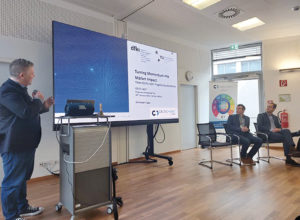
At the beginning of the year, on 30 January 2026, the CELTIC-NEXT community gathered in Vienna for the Proposers Brokerage Day Spring Call 2026, kindly hosted by Austrian Research Promotion Agency (FFG) in Vienna, and supported by the 6G Smart Networks and Services Industry Association (6G-IA).
The event brought together researchers, industry representatives and public authorities with a shared interest in shaping the next generation of communication technologies, and was a valuable opportunity to develop new concepts for future businesses that support a trusted digital transformation in a smart, connected world.
This day was the occasion for many presentations and interactions.
It opened with welcome remarks from Alexander Pogany (BMIMI, Austria), Sonia Nour (EUREKA Secretariat), Colin Willcock (6G-IA) and Xavier Priem (CELTIC-NEXT), who collectively set the scene for the discussions ahead, emphasising collaboration and the importance of cross-border innovation.
The keynote address by Madhusanka Liyanage (University College Dublin) focused on “Future Connectivity Security: Harnessing AI and Quantum for 6G”. It provided a clear overview of the challenges and opportunities linked to securing next-generation networks, particularly in the context of increasingly complex and hybrid technological environments.
A series of national presentations followed, offering a comprehensive view of funding frameworks and priorities across participating countries. Contributions from Michael Walch (Austria, FFG), Juana Sánchez (Spain, CDTI), Justina Ruksnaite (Lithuania), Inyoung Yoo (South Korea, KIAT) and Sanna Edlund (Sweden, Vinnova) were complemented by further insights from Andrzej Wajs (Poland, NCBR), Heikki Uusi Honko (Finland, Business Finland) and Bahriye Özkara (Türkiye, TÜBİTAK). Together, these sessions highlighted both the diversity and alignment of national approaches supporting CELTIC projects.
The business impact session, moderated by Prof. David CastellsRufas (UAB, CELTIC GOE), brought forward concrete examples of ongoing innovation. Christoph Lipps (DFKI) presented key CELTIC flagships—SUSTAINET, AI-NET and SENDATE—while Klaus Chmelina (Geodata) introduced CISSAN, and Christian Raffelsberger (Lakeside Labs) showcased 6GSKY. These presentations illustrated how collaborative research is already contributing to areas such as sustainability, secure connectivity and advanced digital services.
Christoph Lipps (Senior Researcher at DFKI) presenting the success stories of the Flagship Projects SENDATE, AI-NET, and SUSTAINET
The afternoon was dedicated to pitching sessions, where new project ideas were presented by proposers, with coordination moderation from Christiane Reinsch (CELTIC-NEXT Programme Coordinator). These sessions provided a platform for emerging concepts across a broad range of domains, from quantum-enabled security and 6G infrastructures to media applications and digital resilience. The format encouraged concise presentations and direct engagement, paving the way for future consortium building.
The day concluded with a networking session, allowing participants to exchange with proposers and national authorities in a more informal setting. These discussions, often as valuable as the formal sessions themselves, helped initiate connections and refine project ideas.
In conclusion, the Proposers Brokerage Day in Vienna confirmed the continued relevance of CELTIC-NEXT as a platform for collaborative innovation. By bringing together key stakeholders and facilitating both strategic dialogue and practical exchanges, the event contributed to the development of new project ideas supporting a trusted and forward-looking digital transformation.
CELTIC-NEXT is the Eureka Cluster for next-generation communications enabling the inclusive digital society. CELTIC-NEXT stimulates and orchestrates international collaborative projects in the Information and Communications Technology (ICT) domain. The CELTIC-NEXT programme includes a wide scope of ICT topics based on new high-performance communications networks supporting data-rich applications and advanced services, both in the ICT sector and across all vertical sectors.
CELTIC-NEXT is an industry-driven initiative, involving all the major ICT industry players as well as many SMEs, service providers, and research institutions. The CELTIC-NEXT activities are open to all organisations that share the CELTIC-NEXT vision of an inclusive digital society and are willing to collaborate to their own benefit, aligned with their national priorities, to advance the development and uptake of advanced ICT solutions.
A New Opportunity to Drive Next-Generation Communications!
Audrey Bienvenu
CELTIC Office
The CELTIC-NEXT Spring Call 2025 is on the horizon, presenting its bi-annual opportunity for organizations to contribute to ground breaking projects in next-generation communications and help build a more sustainable digital society. The Spring Call 2025 will officially open soon, with a proposal deadline set for 25th of April 2025. Selected proposals will receive notifications by June 2025, marking the beginning of a transformative journey in digital innovation.
CELTIC-NEXT bottom-up Calls foster innovation through collaboration by enabling research and development projects with national public funding opportunities across a vast network of partners, including large industries, SMEs, start-ups, research institutions, and academia. With a proposal success rate of around 50-60%, CELTIC-NEXT creates a supportive environment to accelerate impactful digital technologies for the future.
Upcoming Events for the 2025 Spring Call
As in previous years, CELTIC-NEXT will organize events to support organizations in developing innovative proposals and forming international partnerships. Two main events, online and in-person will be organised to maximize the chance to meet potential consortium partners, learn about funding opportunities, and get insights on topics of interest: a Launch Event and a Proposers’ Brokerage Day.
These events are ideal for networking, connecting with Public Authorities, and receiving guidance on using the Proposal Portal and Brokerage Tool.
Attending these events provides a unique window into the CELTIC ecosystem, allowing you to discuss ideas with Public Authorities, the Group of Experts, and established partners in the field.
Why Apply to the CELTIC-NEXT Spring Call 2025?
› Access National Public Funding: CELTIC-NEXT enables funded R&D projects through partnerships across Europe and beyond, aligning with government priorities for digital advancement.
› Flexible, Low Overhead Management: CELTIC projects are designed with adaptable structures that can range from €1M to €70M and from 2 to over 50 partners, with durations of 24 to 36 months.
› Collaborative Innovation: The CELTIC community is open to a variety of stakeholders, including organizations outside EUREKA countries, ensuring a rich, international mix of expertise.
Steps to Join the Call
› Register for the Online Submission Tool to submit or update your proposal until the deadline.
› Explore Proposal Ideas and use CELTIC-NEXT’s networking tools to find partners.
› Reach Out to the CELTIC Office for any questions to facilitate your involvement and success in the Call.
Connect with the CELTIC-NEXT Community
CELTIC-NEXT is discussing essential and exciting issues on Twitter and LinkedIn.
The latest interviews with the growing CELTIC-NEXT Community and the latest project videos can be found on our YouTube Channel.
CELTIC-NEXT is the Eureka Cluster for next-generation communications enabling the inclusive digital society. CELTIC-NEXT stimulates and orchestrates international collaborative projects in the Information and Communications Technology (ICT) domain. The CELTIC-NEXT programme includes a wide scope of ICT topics based on new high-performance communications networks supporting data-rich applications and advanced services, both in the ICT sector and across all vertical sectors.
CELTIC-NEXT is an industry-driven initiative, involving all the major ICT industry players as well as many SMEs, service providers, and research institutions. The CELTIC-NEXT activities are open to all organisations that share the CELTIC-NEXT vision of an inclusive digital society and are willing to collaborate to their own benefit, aligned with their national priorities, to advance the development and uptake of advanced ICT solutions.








 Further information