Skip to content
  • About Us
    • Company Profile
    • Our Team
    • Shareholders & Members
    • Opportunities
  • Services
    • Launch of Industry-Driven R&D Initiatives
    • Securing of Research Funding
    • Management of European R&D Projects
    • Management of European R&D Programmes
    • Studies on Strategic Topics in ICT
  • EuresTools®
    • EuresTools Reporter
    • EuresTools Tracker
    • EuresTools Workspace
    • EuresTools Website
    • EuresTools Conferencing
    • EuresTools Mailing List
    • EuresTools Pricing
  • Projects
    • Ongoing Projects
    • Past Projects
  • News
    • News
    • Events
    • Eurescom message
  • Contact
    • Travel information
    • Location
×
Linkedin Twitter Youtube
 

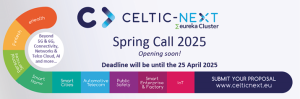
CELTIC-NEXT Spring Call 2025 Opens Soon

A New Opportunity to Drive Next-Generation Communications!


Audrey Bienvenu
CELTIC Office


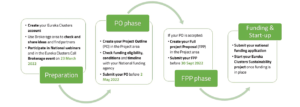
The CELTIC-NEXT Spring Call 2025 is on the horizon, presenting its bi-annual opportunity for organizations to contribute to ground breaking projects in next-generation communications and help build a more sustainable digital society. The Spring Call 2025 will officially open soon, with a proposal deadline set for 25th of April 2025. Selected proposals will receive notifications by June 2025, marking the beginning of a transformative journey in digital innovation.


CELTIC-NEXT bottom-up Calls foster innovation through collaboration by enabling research and development projects with national public funding opportunities across a vast network of partners, including large industries, SMEs, start-ups, research institutions, and academia. With a proposal success rate of around 50-60%, CELTIC-NEXT creates a supportive environment to accelerate impactful digital technologies for the future.

Upcoming Events for the 2025 Spring Call

As in previous years, CELTIC-NEXT will organize events to support organizations in developing innovative proposals and forming international partnerships. Two main events, online and in-person will be organised to maximize the chance to meet potential consortium partners, learn about funding opportunities, and get insights on topics of interest: a Launch Event and a Proposers’ Brokerage Day.

These events are ideal for networking, connecting with Public Authorities, and receiving guidance on using the Proposal Portal and Brokerage Tool.

Attending these events provides a unique window into the CELTIC ecosystem, allowing you to discuss ideas with Public Authorities, the Group of Experts, and established partners in the field.

Why Apply to the CELTIC-NEXT Spring Call 2025?

› Access National Public Funding: CELTIC-NEXT enables funded R&D projects through partnerships across Europe and beyond, aligning with government priorities for digital advancement.
› Flexible, Low Overhead Management: CELTIC projects are designed with adaptable structures that can range from €1M to €70M and from 2 to over 50 partners, with durations of 24 to 36 months.
› Collaborative Innovation: The CELTIC community is open to a variety of stakeholders, including organizations outside EUREKA countries, ensuring a rich, international mix of expertise.

Steps to Join the Call

› Register for the Online Submission Tool to submit or update your proposal until the deadline.
› Explore Proposal Ideas and use CELTIC-NEXT’s networking tools to find partners.
› Reach Out to the CELTIC Office for any questions to facilitate your involvement and success in the Call.

Connect with the CELTIC-NEXT ­Community

CELTIC-NEXT is discussing essential and exciting issues on Twitter and LinkedIn.

The latest interviews with the growing CELTIC-NEXT Community and the latest project videos can be found on our YouTube Channel.

To stay updated on CELTIC-NEXT initiatives, subscribe to our newsletter and follow us on social media.

Don’t miss out on this chance to drive forward the future of digital communications!

Further information

https://www.celticnext.eu/call-information/

About CELTIC-NEXT

CELTIC-NEXT is the Eureka Cluster for next-generation communications enabling the inclusive digital society. CELTIC-NEXT stimulates and orchestrates international collaborative projects in the Information and Communications Technology (ICT) domain. The CELTIC-NEXT programme includes a wide scope of ICT topics based on new high-performance communications networks supporting data-rich applications and advanced services, both in the ICT sector and across all vertical sectors.

CELTIC-NEXT is an industry-driven initiative, involving all the major ICT industry players as well as many SMEs, service providers, and research institutions. The CELTIC-NEXT activities are open to all organisations that share the CELTIC-NEXT vision of an inclusive digital society and are willing to collaborate to their own benefit, aligned with their national priorities, to advance the development and uptake of advanced ICT solutions.

CELTIC-NEXT website – https://www.celticnext.eu/

CELTIC-NEXT Cluster

CELTIC-NEXT AI-NET ANIARA Highlights

Compute and AI enablers for an intelligent and sustainable 6G platform


Ali Balador
Ericsson

Modern society expects increasingly ad­-vanced digital applications to be available anytime and anywhere. To make future mobile networks ready in terms of performance and functionality for use-case scenarios like Smart Cities and Smart Manufacturing, new computation and Artificial Intelligence (AI) enablers need to be provided for future mobile networks to transform them into a communication platform offering services that go beyond communication.

AI-NET-ANIARA is a flagship CELTIC-NEXT project where three EU countries were involved including Sweden, Germany, and UK. The project ended in February 2024. This innovative project provided several technology enablers and showed exciting demonstrations of these technologies that will change the world of communication. The project goal was to complement the evolution of 5G with crucial technical enablers towards an intelligent and sustainable 6G platform, offering services beyond pure communication, including compute & AI.

Project results:

› Carrier grade AI technologies for telecom edge automation, and intelligent management in support of services with guarantees on performance and energy consumption.
› Novel AI concepts such as robust and reliable federated learning, reinforcement learning for service mesh, intelligent feature selection, and transfer learning.
› MLOps infrastructure for AI. ANIARA extended the Feature store solution by ANIARA partner Hopsworks to support real-time model serving all the way to the edge.
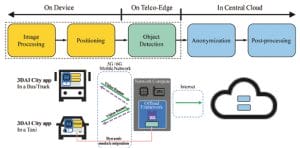
› Execution runtime to process edge applications using WebAssembly. A dynamic computational offloading solution was developed and its potential as a future 6G service has successfully been demonstrated on the SmartCity application by ANIARA partner Univrses.
› A modifed Kubernetes scheduler enabling the allocation of workloads based on the energy state of nodes and/or devices. This modification improved the energy efficiency of the system. Furthermore, the project designed a new resource scheduling mechanism for Kubernetes that can closely match the time-varying traffic profile of users. This led to a 30% improvement in resource efficiency.
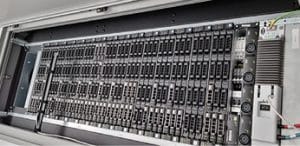
› Designed, built, and operated two versions of Aniara Edge node data center demonstrators. These demonstrators include a fresh air cooling approach, where the cooling system is highly integrated in the Edge node design. An intelligent power system ensures that the servers are provided with enough power also during periods of limited external power supply and a photovoltaic system to reduce the amount of power from the grid, improve the sustainability and maximise robustness.
› Developed new edge processing devices deployed in Stellantis manufacturing sites that monitor energy consumption and machine condition. This data is then transmitted wirelessly to, for example, optimize the energy consumption in the paint shop.

Conclusions:

CELTIC-NEXT project AI-NET ANIARA provides technical enablers for an intelligent and sustainable 6G platform in line with the ITU-R IMT 2030 recommendations. AI-NET ANIARA project designs and builds robust and energy efficient mini edge datacenter infrastructure. For efficient use of distributed edge resource, improvements presented the existing resource orchestration methods. Moreover, to support automated operations of 6G networks and their functions, several studies have been performed on scalable distributed intelligence methods. Finally, AI-NET ANIARA contributed with innovative service ideas that go beyond pure communication, increasing future network platforms usage vector by compute & AI services exposed to applications. These include privacy preserving AI/data services, a real-time online features store for edge applications, as well as a dynamic device offloading service to improve the experience of mobile devices and apps.

Overall, AI-NET-ANIARA was successfully living up to its project promises of accelerating digital transformation by the efficient use of a highly integrated and flexible edge infrastructure that is programmable across all its components.


Figure 1: Dynamic device offloading for a SmartCity app


Figure 2: ANIARA Edge data center


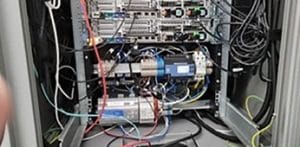
Figure 3: Closer look of the stack

CELTIC-NEXT website – https://www.celticnext.eu/

CELTIC-NEXT Cluster

Giant Steps Toward 6G: Secure and Lightweight Network Automation at the Telco-Edge

AI-NET Closing event – co-located with 6G Platform Event Berlin, Germany


Christiane Reinsch
CELTIC-NEXT Programme Coordinator

On July 2, 2024, the CELTIC flagship project AI-NET marked a significant milestone in Europe’s journey toward secure and autonomous networking at the telco-edge, presenting its achievements at the 6G Platform Event in Berlin, Germany. Hosted at the Berlin Congress Center, the 6G Platform event gathered prominent leaders from research, industry, and government to discuss the future of communications technology in the 6G era. The afternoon session was dedicated to AI-NET’s Closing Event, where high-level representatives and project leaders highlighted AI-NET’s impact on the European digital landscape and the advancements it has fostered for telco-edge automation.

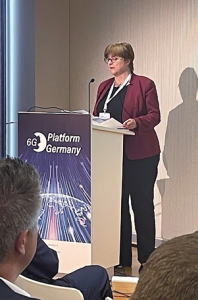
Opening and moderating the Closing Event, Mr. David Kennedy, CELTIC Chairman from Eurescom, Germany, set the tone by emphasizing AI-NET’s pivotal role in future 6G development. Ms. Heike Prasse, Head of Kommunikation und Sicherheit digitaler Systeme at Germany’s Federal Ministry of Education and Research (BMBF), welcomed attendees by stressing the importance of network automation within the evolving 6G ecosystem, noting that AI-NET positions Europe as a leader in this field. Representing the UK, Mr. Tom Kirkham, Innovation Lead for Future Network Technologies at Innovate UK, praised the role AI-NET has played in advancing UK companies and research institutes that joined under the AI-NET ANIARA subproject in 2019, citing its early contributions to edge automation as a cornerstone for the future. From Finland, Mr. Heikki Uusi-Honko, Chief Advisor for Development and International Activities at Business Finland, celebrated the substantial impact Finnish partners have made through their involvement in the AI-NET subproject ANTILLAS. This introductory session was followed by the presentation of success stories from each of the three AI-NET subprojects: AI-NET-PROTECT, AI-NET-ANTILLAS, and AI-NET-ANIARA, highlighting AI-NET’s overall influence in enhancing Europe’s competitive advantage in networking technology.

Mr. Peter Elbers, CELTIC Core Group Member and Vice President of Advanced Technology at ADTRAN, Germany, underlined the critical role of resilient infrastructure in countering future threats, expressing pride in the AI-NET PROTECT team’s achievement of surpassing Key Performance Indicators. Mr. Volker Ziegler, Senior Technology Advisor at Nokia, followed with insights into how these advancements are integral to Nokia’s broader strategy. Mr. Paolo Monti elaborated on the competitive edge that AI-NET ANIARA has given its participants, while Mr. Achim Authenrieth, Director of Advanced Technologies at ADTRAN, Germany, highlighted the cooperative success of the flagship project and its subprojects.

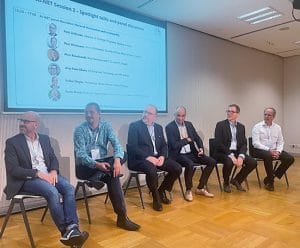
The Closing Event concluded with “Spotlight Talks” and an engaging panel discussion led by Mr. David Kennedy, CELTIC-NEXT Chairperson. The panel, featuring prominent voices such as Mr. Petri Jehkonen, Director of Strategic Programs at Xiphera, Finland; Mr. Peer Wichmann, Chief Information Security Officer at Wibu-Systems, Germany; and Mr. Piotr Pawłowski, Vice President and CTO of MedVc, Poland, provided attendees with forward-looking perspectives on AI-driven network automation and security at the telco-edge cloud.

AI-NET’s Closing Event highlighted the strides Europe has taken toward secure, autonomous 6G network technologies, solidifying the foundation for future innovations in secure telco-edge cloud architecture.


Ms. Heike Prasse from Germany Federal Ministry of Education and Research (BMBF)


Panel discussion on AI-driven Network Automation and Security


AI-NET closure event attendees

CELTIC-NEXT website – https://www.celticnext.eu/

AI-NET project website: https://www.celticnext.eu/project-ai-net/

CELTIC-NEXT Cluster

Celebrating Innovation

CELTIC Awards Honor Three Outstanding Projects in Green Networking, Applications, and 6G Innovation


Christiane Reinsch
CELTIC-NEXT Programme Coordinator

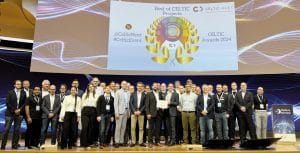
At the CELTIC 21st Anniversary Ceremony co-located with the Berlin 6G Platform Event at BCC in Berlin, Germany on 2nd of July 2024, 3 projects won the CELTIC award for their outstanding work. One of these projects have been awarded for their excellence in the areas of green networking, and another one for excellent achievements in the category of applications and services. The Third was honoured with the Innovation Award for its outstanding innovations and high number of key performance indicators.

The awards were presented to the winners by the CELTIC-NEXT Chairperson Mr. David Kennedy from Eurescom as well as by the representative of the Public Authority Mrs Juana Sanchez (CDTI, Spain).

CELTIC-NEXT Innovation Award:

AI-NET – Accelerating digital ­transformation in Europe by Intelligent NETwork automation

The Innovation Award 2024 was handed over to the overall project leader Mr Achim Autenrieth, ADTRAN, Germany.

AI-NET has achieved remarkable progress in 6G enabling technologies, complementing existing 5G solutions with a focus on edge-centric compute and artificial intelligence. These advancements are seen as instrumental in shaping new, secure services and application platforms. Notably, AI-NET has successfully demonstrated excellent results in developing sustainable compute platforms that support AI on top of the communications system. Additionally, AI-NET has introduced highly competitive solutions, particularly in the area of energy-efficient edge data centres. These solutions are nearing the performance of leading hyper-scaler technologies, achieving a power usage effectiveness (PUE) in the range of 1.0 to 1.2 PUE.

This clearly highlights the competitive edge the project has achieved in addressing global challenges, contributing to Europe’s future prosperity and competitiveness. The project has demonstrated scientific excellence in the area of future 6G technologies, while also meeting ambitious key performance indicators (KPIs) crucial to securing future markets for 6G deployment.

In total, 316 scientific publications in leading international journals and conferences, supported by 184 PhD and Master’s theses, have been successfully accepted and completed. A strong business impact is anticipated from 72 contributions to intellectual property rights (IPR), open-source projects, and standards. The project’s excellence is further emphasized by 77 Proof of Concepts, 70 keynote presentations, and the hiring of 43 professionals.

The project focused on timely solutions for enhancing security, sustainability, performance, and cost efficiency of AI in future telecom networks. This included energy metering in real industrial environments, hybrid IT management solutions, and incremental manufacturing processes. Furthermore, optimized power distribution, in synergy with network management, and lightweight software layer solutions offer telecom customers an effective entry point to access telco cloud services. New AI algorithms featuring federated learning (FL) alongside unlearning techniques, coupled with overfitting parameter analysis and smart clustering solutions, have demonstrated significant potential for large-scale data savings when deployed on a computing platform.

CELTIC Excellence Award for Green Networking:

AI4Green – Artificial Intelligence for Green networks

The Excellence Award 2024 in the category green networking was handed over to the project leader Mrs Cicek Cavdar from KTH, Sweden.

AI4Green addresses the critical need for energy-efficient and advanced algorithms that span the entire telecommunications ecosystem, from radio access and core networks to data centers and storage. With a focus on adapting to new architectures and integrating smart grid technologies, the project has been pivotal in pushing for sustainable solutions. It set ambitious energy-saving targets of 30-40%, yet exceeded these goals through AI-driven enhancements in energy savings and fault detection. The outcomes of AI4Green range from pioneering research to tangible products and contributions to standardization efforts.

High energy savings were consistently achieved through advanced techniques, such as implementing AI-driven sleep modes that adaptively manage network resources. AI4Green’s data analysis leveraged vast datasets, including environmental monitoring (radar data and signal propagation), operator network metrics (traffic, deployment, and performance), and mobile user data (crowdsourced insights and usage patterns). Testing on live operator networks provided real-world validation, with a significant pilot conducted in one of Istanbul’s busiest areas. Here, AI-assisted sector and carrier shutdowns demonstrated 14% energy savings, with an additional 10% improvement over traditional model-based approaches for selective sector deactivation.

In scenarios with fluctuating demand, such as large gatherings or events, AI-enabled mobility prediction was instrumental in optimizing energy usage. By forecasting crowd movements in real-time, energy-saving modes could be activated selectively across more than 50% of cells for extended periods—achieving substantial savings post-event, such as five hours after a major football game in Istanbul’s city center.

AI4Green also advanced novel architectures like cell-free massive MIMO atop virtualized cloud RAN. Here, intelligent access point clustering and selective deactivation with AI reduced energy usage, particularly through 5G base stations with large antenna arrays configured to exploit advanced sleep modes. These methods achieved energy savings surpassing 30%, demonstrating the power of combining AI with deep-sleep functionalities in modern telecom networks.

AI also enabled efficient fault detection, eliminating the need for extensive drive testing by utilizing robust data analytics and predictive algorithms. By integrating AI into core operations, AI4Green has contributed essential solutions to building energy-efficient, sustainable telecommunications networks for the future.

CELTIC-NEXT Excellence Award for Services and Applications:

5GPerfecta – 5G and next-generation mobile Performance compliance testing assurance

The Excellence Award 2024 in the category of applications and services has been handed over to the project coordinator Mr Antonio Cuadra Sánchez, Minsait, Spain.

The project made significant contributions to analyzing and supervising 5G network performance, developing technologies for 5G monitoring, and overseeing 5G services, applications, and measurement devices. With 5G deployment under way and ongoing demand for insights and optimizations, the project is of high relevance to real-world business operations for telecom operators and service providers. Its impact is underscored by its early alignment with the practical needs of 5G deployment, making it particularly valuable for operators looking to maximize network efficiency and service quality from the outset.

A balanced consortium drove the project’s success, bringing together operators, vendors of 5G equipment, small and medium enterprises, and academic institutions. This diverse partnership enabled a broad spectrum of use cases relevant to business, covering essential 5G service categories—enhanced broadband, mission-critical applications, remote machine operations, and IoT services.

The project’s outcomes reflect high quality, as shown by 86 contributions to the broader 5G technology landscape through 5G PERFECTA, which facilitates the dissemination of key innovations. These contributions include 37 publications in prestigious international journals, conferences, and symposiums, seven currently under review, one PhD thesis, nine MSc theses, 10 contributions to standards bodies (ITU-T, VQEG, and TM Forum), and participation in 22 exhibitions and events.

This high perceived quality has been reinforced by direct feedback from seven major exhibitions and events, including the CELTIC-NEXT Event at EUCNC 2019 in Valencia, the VQEG Meeting in Shenzhen, AfricaCom 2019, 5G Forum Day in May 2021, 5G World London 2020, and the joint workshop between CELTIC-NEXT projects in October 2020. These events provided valuable platforms for industry feedback, demonstrating the project’s influence and relevance in advancing 5G standards, innovation, and business applications globally.


Awardees of Innovation Awards 2024

CELTIC-NEXT website – https://www.celticnext.eu/

CELTIC-NEXT Cluster

CELTIC-NEXT Autumn Call 2024 Proposers’ ­Brokerage Day – 18th September 2024 at Digital Catapult in London


Audrey Bienvenu
CELTIC Office

On Wednesday, 18th September 2024, CELTIC-NEXT held its Proposers’ Brokerage Day for the Autumn Call 2024 at Digital Catapult in London. This event brought together innovators and experts to explore opportunities in next-generation communications that contribute to a sustainable digital society. Attendees were invited to engage with the CELTIC-NEXT Cluster and explore funding opportunities for groundbreaking R&D projects.

The event featured keynotes, panels, and project pitches.

In the morning, Dr. Dritan Kaleshi from DIGITAL CATAPULT LONDON opened the day with a presentation on “5G and Digital Infrastructure SONIC Labs & UKTIN Founder” followed by Xavier Priem, Director of the CELTIC-NEXT Cluster who introduced the cluster.

These presentations were followed by a keynote from Kostas Katsaros, Head of Technologies at Digital Catapult, on “Towards a sustainable connected world”.

The exchange at the event helped participants to gain insights into national funding opportunities, such as presentations from Innovate UK, CDTI Spain, and Bpifrance.

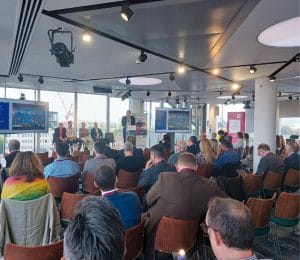
The morning session wrapped up with a panel moderated by Richard Foggie highlighted the business impacts of successful CELTIC projects.

The day engaged the stakeholders with innovative pitching session moderated by Christiane Reinsch, CELTIC-NEXT Project Coordinator, this was the occasion for 11 project proposers to pitch their new project ideas, offering them visibility and potential future collaboration.

Post pitches, a networking time was organised for attendees to network with national funding authorities and project proposers to foster collaboration.

The event concluded with a guided tour of Future Networks and SONIC Labs, offering a closer look at the innovations driving the future of communications.


Panel discussion on Business impacts of successful CELTIC projects at the Proposers Brokerage Day 2024

CELTIC-NEXT Cluster

CELTIC 21st Anniversary Celebration at the Berlin 6G Conference 2024 – 2nd to 4th July 2024


Audrey Bienvenu
CELTIC Office

The CELTIC-NEXT 21st Anniversary was co-located with the Berlin 6G Platform Event at BCC in Berlin between the 2nd and 4th of July 2024!

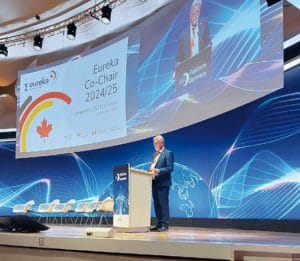
On the morning of the 2nd of July 2024, CELTIC-NEXT celebrated its 21 years of existence on the scene of international cooperation fostering innovation in the ICT domain and its application verticals. During this day, opening keynotes were organised including a welcome keynote by the Chairman David Kennedy, followed by the Eureka Chair Dr Rudolf Haggenmueller celebrating Eureka in CELTIC, BMBF Ministry delegate Frau Dr Tina Kluwer.


Welcome keynote by Rudolf Haggenmüller on the Eureka Joint Presidency

All these high-level speakers from BMBF, Eureka and the Industry shared the floor of the plenary auditorium and expressed themselves on CELTIC, its great achievements and their vision of its future.

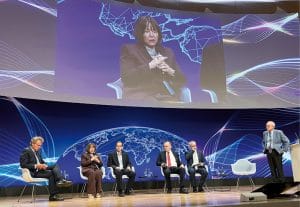
The session was followed by a Panel discussion on “Future Persuasive Networks – and how to build them” moderated by David Kennedy, CELTIC-NEXT Chairman.


Panel discussion on Future Persuasive Networks

This panel discussed the visions shared by 5 panellists:

› Mr Engelbert Beyer (BMBF, Dept 51),

› Mikko A. Uusitalo (Coordinator 6G Flagship Hexa-X II),

› Johannes Springer (DTAG),

› Maria Guta (ESA), and

› Hans Schotten (6G Platform Germany)

The context of the discussion was the following:

During the last 5 years, the Communications network, because of Corona and other factors, became recognised as a facilitator for changing not just how we work – but as a core enabler for a whole new structure of our lives. The new era communications networks will be pervasive, providing everything to everyone at any time – for the traveller, it will be continuous connectivity, for the remote worker, it will be additional processing, for the home entertainment, it will be high quality throughput at a low price and for the professional sectors, it will be a combination of processing, AI, low latency, low power and edge computing as and where they need it.

The question is how will this be provided? Clearly the new network must be highly software based and infinitely customisable. It must be flexible and easily repurposed and or expandable. In fact, it must be intelligent and capable of learning how to supply what the users want before even they themselves know. And it must be cost/resources and power efficient. And fully automatised while secure and trustable because it remains explainable and controllable.

After that a CELTIC-NEXT Awards Ceremony was organised, rewarding 3 projects in the fields of green networking, applications & services and outstanding innovation.

We wrote a dedicated article on this occasion: https://www.eurescom.eu/eurescom-messages/winter-2024/celebrating-innovation/

CELTIC-NEXT website – https://www.celticnext.eu/

CELTIC-NEXT Cluster

How to submit a high-quality proposal

5 key steps & 5 factors for a successful CELTIC-NEXT proposal


Audrey Bienvenu
CELTIC Office

CELTIC-NEXT is an industry-driven European research initiative to define, perform and finance through public and private funding common research projects. As the follow-on programme to the successful Eureka ICT cluster Celtic-Plus and its predecessor “Celtic-Initiative”, the cluster has been defined for 8 years until the end of 2026. CELTIC is supported by nearly all major European players in telecommunications. Bringing the major European telecommunications vendors and operators together into an ambitious European intergovernmental R&D programme, CELTIC is the best option to address a “system view” of communications to complement other existing Clusters.

CELTIC has been key for initiating ambitious and innovative projects dedicated to end-to-end communications solutions. Until today, CELTIC has labelled, funded and performed 176 projects in all their research areas with a total volume of more than one Billion Euro. By facilitating these collaborative R&D projects, CELTIC has made a great contribution to help Europe to stay at the competitive edge of the telecommunications industry.

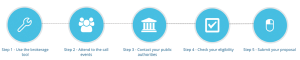
Through 21 years of successfully running, the office has gathered the best tips and 5 key steps to submit a high-quality proposal and a rewarding project.

Step 1 – Use the brokerage tool

In order to support you in preparing your project proposal for CELTIC-NEXT Calls, we have created an online Brokerage Tool. Its goal is to help you build your Consortium in preparation for your CELTIC-NEXT Project. The tool functionalities are the following:

› Submission form for your Project Ideas and Expertise Offers
› Overview lists with search form
› Contact request forms
› Process owner support functions: approval process and contact request tracking

Step 2 – Attend to the call events

CELTIC-NEXT organises several events open to the public, which interested parties can attend to learn more about CELTIC-NEXT. We have typically one large CELTIC-NEXT Event per year, including an exhibition where running projects show their results. In addition, we are running several Launch Call Events and Proposers Days every year where interested parties can discuss their project ideas and potential project proposals with other interested experts and with representatives from the Public Authorities. Please watch out for upcoming CELTIC-NEXT Events.

Step 3 – Contact your public authorities

Projects can receive public funding, depending on the national funding rules. To speed up the funding decision process, each project participant should contact their national funding agency early in the process and follow their advice regarding national funding applications in parallel to the proposal submission. You may submit a short proposal abstract (including a short project outline, and intended consortium partners/countries) until one month before the deadline for a first check to the CELTIC Office.

Step 4 – Check your (funding) eligibility

Project proposals for CELTIC-NEXT Calls must meet specific criteria.The consortium should include at least two companies from different Eureka participating countries include at least one industrial partner from each of the countries and in a fair and well-balanced way. The project should generate an obvious advantage and added value resulting from the technological cooperation between the participants.

Step 5 – Submit your proposal in the CELTIC ­Proposal Submission Portal

First of all, you will need to create an account on the CELTIC Proposal Submission Portal https://cluster-projects.eurestools.eu/. Once your account is created, all steps and documents needed for upload will be explained.

5 factors for a successful project

› Targeting the research areas: Least but not last: CELTIC-NEXT focuses on telecommunication and ICT, connecting people and businesses securely and reliably. The topics in the picture are not prescriptive and are only meant to give you some idea of the wide scope. Any topic related to the CELTIC-NEXT vision of a Smart Connected World is eligible.
› Market relevance and exploitation potential: These are Key aspects to motivate Public Authorities to fund your project. The market analysis includes the technological value chain and added value of the collaboration, value chain as the right mix of partners in the consortium, added value of the cooperation at a technology level, added value by the cooperation at a business level, and consortium/partner access to the market.
› Technology innovation: Innovation above the State of the Art (SoA) is a Key Criterion; 50 % of criticism of the Cluster experts during proposal evaluation are related to insufficient description of the SoA. Strategic relevance and expected impact of your proposal on a per-country perspective such as what new businesses will be generated matters.
› Right mix of participating countries: A large majority of successful projects in the past have been funded and built by a minimum of three different countries. A total of 44 European and non-European countries worldwide are participating in CELTIC-NEXT, of which 27 are coming from Eureka countries.
› Knowing the process of the proposal submission: The CELTIC label decision is given in 3 stages: Proposal Submission by proposers, evaluation phase by Industry Experts and Public Authorities and lastly, Label Decision by the Public Authorities and CELTIC Core Group.

› Further information

CELTIC-NEXT website – https://www.celticnext.eu/

CELTIC-NEXT Cluster

On the road to future networks

CELTIC Event in Valencia

This year’s CELTIC Event took place in Valencia, Spain on 19th to 20th June. It was co-located with EuCNC, the European Conference on Networks and Communications, which gave CELTIC-NEXT additional attention among the 5,000+ EuCNC participants. The CELTIC Event consisted of a conference with award ceremony on day 1 and sessions for project proposers on day 2. In parallel, 15 selected CELTIC projects showed their results in the exhibition at the Valencia Conference Centre. One of the highlights of this year’s event was the emergency communication demo at the harbour of Valencia, which was performed by CELTIC project UNICRINF.
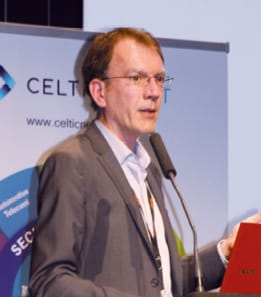
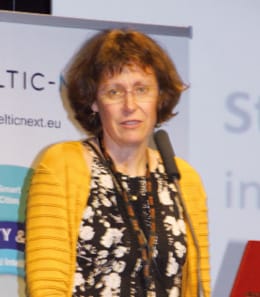
                          
Eric Hardouin, Ambient Connectivity Research      Valérie Blavette, chairperson of CELTIC-NEXT, Director at Orange

Keynotes and SME success story

In the first keynote, Eric Hardouin, Ambient Connectivity Research Director at Orange, presented a vision of future networks. He emphasised that beyond performance aspects, research on future networks has to address a number of additional challenges, including trust and resilience in multi-tenant environments, EMF-aware transmissions, the efficiency of energy and natural resource usage as well as digital inclusion. He pointed out that there is still a lot of research needed to deliver the full 5G potential. According to Mr Hardouin, the exploding complexity of networks due to multiple requirements for optimisation calls for system-level solutions.

In the second keynote, Diego R. Lopez from Telefónica I+D shared his insights on the application of Artificial Intelligence (AI) to network transformation for nurturing the Smart Network. According to Mr Lopez, such a network should be smart in all senses, i.e. fast, simple to use, easy to tune, and above all, intelligent in order to make the network scalable, adaptable, multi-purpose, and suitable for integration.

The third speaker, Steny Solitude from French SME Perfect Memory, shared the story of his company’s success, which is closely linked to its participation in CELTIC projects. Perfect Memory has created an innovative digital asset management (DAM) solution based on results by CELTIC projects MediaMap and MediaMap+.
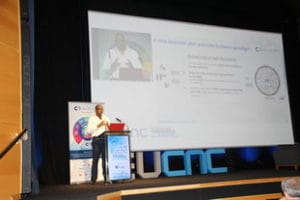
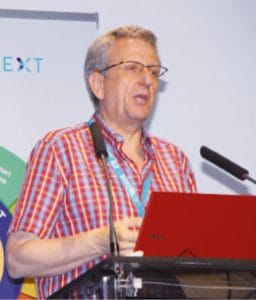
                                  
Steny Solitude from French SME Perfect Memory                     Diego R. Lopez from Telefónica I+D

In the second keynote, Diego R. Lopez from Telefónica I+D shared his insights on the application of Artificial Intelligence (AI) to network transformation for nurturing the Smart Network. According to Mr Lopez, such a network should be smart in all senses, i.e. fast, simple to use, easy to tune, and above all, intelligent in order to make the network scalable, adaptable, multi-purpose, and suitable for integration.

The third speaker, Steny Solitude from French SME Perfect Memory, shared the story of his company’s success, which is closely linked to its participation in CELTIC projects. Perfect Memory has created an innovative digital asset management (DAM) solution based on results by CELTIC projects MediaMap and MediaMap+.

Panel on impact of CELTIC projects

After the opening keynote, the audience witnessed a lively panel session on the impact of CELTIC projects, which was emceed by David Kennedy, director of Eurescom. The five panellists represented six CELTIC projects: 4KREPROSIS – Marco Mattavelli, EPFL, Switzerland; flagship project SENDATE – Emmanuel Dotaro, Thales, France; NOTTS and MONALIS – Antonio Cuadra Sanchez, INDRA, Spain; SIGMONA – José Costa Requena, Cumucore, Finland; and UPSC – Isil Ozkan, Turkcell, Turkey.

Not surprisingly, all five panellists concluded that the industry-driven and close-to-market projects under CELTIC allowed their organisations to reap immediate benefits in terms of accelerating market innovations, sustained competitiveness, and a profound increase of their knowledge base and international business connections. The type and scope of these impacts varied widely, due to the fact that the panellists represented on the one hand large companies like Thales or Turkcell and on the other hand SMEs like Cumucore.
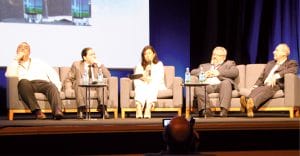

Panellists discussing the impact of CELTIC projects (from left):
José Costa Requena, Cumucore; Antonio Cuadra Sanchez, INDRA;
Emmanuel Dotaro, Thales; Işıl Özkan, Turkcell; Marco Mattavelli, EPFL

CELTIC Awards

The first day of the CELTIC Event ended with a highlight – the CELTIC Awards. Four CELTIC projects won the CELTIC Award for their outstanding work. Three of these projects were awarded for their excellence in the areas of networking technologies, applications, and multimedia. The fourth was honoured with the Innovation Award for its outstanding market innovation beyond the project lifespan. The awards were presented to representatives of the winning projects by CELTIC-NEXT chairperson Valérie Blavette and handed over by Juana Sanchez from CDTI, the representative of the Public Authority in Spain.
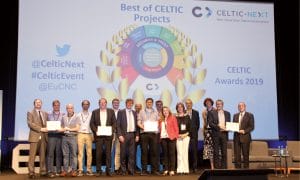
Excellence Award for Multimedia:

4KREPROSYS – 4K ultraHD TV wireless REmote PROduction SYStems

The project partners have been very successful in their specialized video production ecosystem. The business relevance of the developed 4KREPROSYS solution has been evaluated as very high. The successful involvement in major events like the FIFA World-Cup 2018 underlines the competitiveness of the solutions brought forward by the project.

Coordinator: Dominique Grillet, AMP Visual TV
Duration: December 2014 – June 2018
Project Video – https://youtu.be/NNvWkSVlpHo
Website – https://www.celticnext.eu/project-4kreprosys
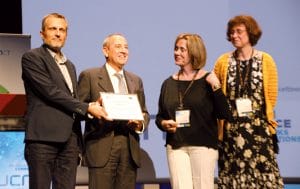

François Valadoux, AMP Visual TV, France and Marco
Mattavelli, EPFL, Switzerland, from 4KREPROSYS;
Juana Sanchez, CDTI, Spain; and Valérie Blavette,
CELTIC-NEXT Chairperson  

Excellence Award for Network ­Technologies: SOOGREEN – Service-oriented optimization of Green mobile networks

SooGreen’s main objectives were to reduce the energy consumption of services and to improve the mobile network architectures and content delivery, taking advantage of the smart grids by using a holistic approach at the level of network components, architecture, management and control. The project has addressed the need to reduce the energy consumption of services in different mobile network architectures, focusing on topics like modelling and measurement of services ­energy consumption in mobile networks; ­dynamic optimization in access; energy-efficiency aspects of emerging virtual and cloud RAN architectures; and interaction between service delivery in mobile networks and smart grids.

Coordinator: Dominique Bodere, Orange
Duration: July 2015 – November 2018
Project Video – https://www.youtube.com/watch?v=rVZfvAaHUIA&t=47s
Website – https://www.celticnext.eu/project-soogreen
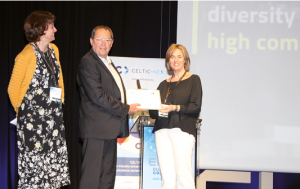

Valérie Blavette, CELTIC-NEXT Chairperson; Dominique
Bodere, SOOGREEN Project Coordinator from Orange,
France and Juana Sanchez from CDTI, Spain (from left)

Excellence Award for Applications:

E3 – E-health services Everywhere and for Everybody

E3 designed and implemented an end-to-end platform to make e-health services available in both rural and urban areas, to patients and professionals. E3 used and extended the results from the awarded CELTIC project HIPERMED. E3 developed the HIPERMED results further by addressing other communication types and compression techniques. In addition, E3 extended the type of scenarios by testing the developments in 15 healthcare scenarios, which were validated by doctors and professors who tested the platform results.

Project Coordinator: Oscar Chabrera Villarreal, ViLynx Spain S.L.U.
Duration: December 2014 – June 2018
Project Video – https://www.youtube.com/watch?v=X7_fH8wUQDw
Website – https://www.celticnext.eu/project-e3
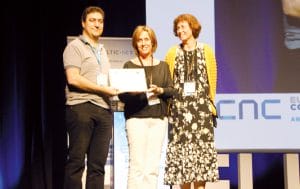

E3 project coordinator Oscar Chabrera from Vilynx, Spain
and Juana Sanchez from CDTI, Spain, and Valérie Blavette,
CELTIC-NEXT Chairperson

Innovation Award:

NOTTS – Next generation Over-The-Top multimedia Services

The project had developed a sustainable integrated solution to guarantee the OTT content delivery from the customer’s perspective for the whole content distribution chain. The main activities included new media distribution architectures for OTT contents, and novel methods for Quality of Experience (QoE) estimation. NOTTS technology has supplied European content providers, service providers and telecoms network operators with new technologies that allow increasing revenue from new OTT business models.

Project Coordinator: Antonio Quadra Sanchez, INDRA Spain
Duration: May 2013 – 31 March 2016
Project Video – https://www.youtube.com/watch?v=UmQn2o-7Ak4
Website – https://www.celticnext.eu/project-notts
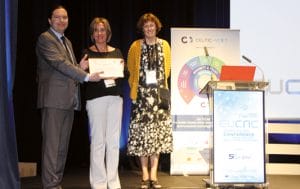

NOTTS Project Coordinator Antonio Quadra Sanchez from
INDRA Spain, Juana Sanchez from CDTI, and Valérie Blavette,
CELTIC-NEXT Chairperson

Exhibition

In the EuCNC exhibition area, 15 commercially important CELTIC projects presented their results. Visitors had the chance to experience first-hand prototypes of solutions which have been developed in the selected CELTIC projects. The demos allowed visitors to experience the technological progress made by those projects in an interactive and playful way.
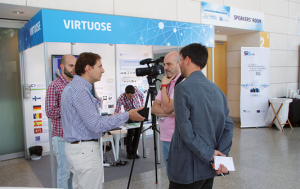

Exhibition – High media interest in CELTIC projects, here the VIRTUOSE project

Live emergency demo at the harbour

Shortly before the EuCNC social event on 18th June, CELTIC project UNICRINF showcased a live emergency demo at the Port of Valencia. The demo attracted a large number of visitors who witnessed how the UNCRINF solution enabled the communication between emergency teams on land, in the air, and at sea.
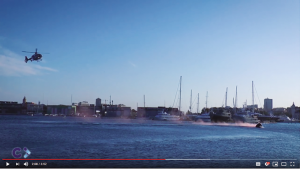
 

The video of the live demo is available on the CELTIC YouTube channel at https://youtu.be/b2wFQ6eB6Zo

See also the article about UNICRINF in this edition of CELTIC News.

Sessions for proposers

The sessions on the second day were dedicated to helping proposers learn about making a good proposal for the upcoming autumn call in October and finding the right partners for their consortium. In the first session, CELTIC Office Director Peter Hermann presented best practices for proposers and explained how to set up a successful CELTIC project. The ensuing round-table with representatives of Public Authorities provided practical information on funding and research topics in different EUREKA countries.

The afternoon was dedicated to project idea pitches and networking. This offered ample opportunities for meeting other experts from the ICT community to discuss emerging R&D needs and proposals for related collaborative projects. Session moderator Christiane Reinsch, Programme Coordinator at the CELTIC Office, introduced 17 new project ideas. This was followed by proposers, who pitched their innovative project ideas for the upcoming CELTIC call in short elevator pitches. The CELTIC Event ended with open networking and bilateral discussions between proposers and representatives of Public Authorities.

Further information

CELTIC Event 2019 page – https://www.celticnext.eu/event/celtic-event-co-located-with-­eucnc-19-20-june-in-valencia-spain/

Implementing the new roadmap

How CELTIC-NEXT is delivering on its new ambitions


Xavier Priem
Director CELTIC Office

For CELTIC-NEXT, 2021 was a year of renewal and change. 2022 is a year of implementation: translating the new roadmap into partnerships and calls, designing the Space ICT flagship programme, acquiring new Core Group memberships, and implementing the first official inter-cluster joint thematic call of the Eureka Clusters Programme on accelerating industrial sustainability.

Solidarity with Ukrainian colleagues

Before going into the other topics, let me first share on behalf of the CELTIC Office our deepest compassion with our Ukrainian colleagues and their families. We are worried about the destiny of those who were not able to flee or had to stay and fight the invader. Our attempt to contact them was not successful. Our only hope is that this is because our contact attempt was their lowest priority, and they did not find the time and energy to answer.

Translating the new roadmap into ­partnerships and calls

In the first half of 2022, we have pursued the implementation of CELTIC’s new roadmap by running several actions, and we will continue to do so in the second half. We are presenting this roadmap in our Proposers’ Days, to allow consortia to propose innovative projects in the large number of fields of technologies, applications, and verticals of the roadmap. This is our traditional bottom-up approach. We will continue to run our Spring and Autumn Calls as per our successful history. This is a unique selling point of CELTIC as a Eureka Cluster compared to other international funding schemes. And it will remain so in the future.

Secondly, we are entering into new partnerships to enhance our funding impact in the global ICT community, as well as in other industries. Those partnerships will nourish further our roadmap and attractivity to Public Authorities to fund impactful innovative projects across and beyond the Eureka and European countries. This is already bearing fruits with the joining of two new CELTIC Core Group members: SES S.A. and CELLNEX Telecom.

One of the new partnerships has already been signed with ESA, the European Space Agency, in the form of a Memorandum of Intent (see the Space ICT article in this issue of CELTIC News). CELTIC and ESA will coordinate efforts and exchange on terrestrial network and non-terrestrial network convergence and cooperation. Some of those new partnerships, as for example the one with ESA, will be translated into flagship programmes and associated calls.

Designing the Space ICT flagship ­programme

Space ICT has become a subject of high attention for industry and governments, and this has been strongly reinforced by the effects of the COVID-19 pandemic and the war in Ukraine. A clear sign has been also sent by 3GPP, which has now opened wider doors for the inclusion of SatCom besides the traditional backhauling role. The MoI will encourage terrestrial ICT and Space ICT industry collaboration with other industry verticals to facilitate the adoption of advanced Space ICT technologies in the business models and processes of all industry sectors.

CELTIC-NEXT and ESA are working together to define a joint roadmap of technologies, use cases and agenda of calls. ESA is a key actor in the development of all aspects and fields of space activity. Once the first roadmap and an agenda of calls are ready, CELTIC and ESA will advertise them. The joint roadmap and agenda should be defined during the first half of 2022, and the first CELTIC Space ICT flagship call should be announced for the second half of 2022.

New Core Group members

CELTIC has started to approach potential new Core Group members to enrich its DNA. And CELTIC is proud to have added two strong new members with headquarters based in Europe to its Core Group:

SES S.A. is a leading satellite operator. With over 70 satellites in two different orbits, their reach is unlike any other. They combine a vast, intelligent network of satellites and ground infrastructure with industry-leading expertise to manage and deliver high-performance video and data solutions virtually everywhere on the planet. SES S.A. already delivered a keynote in the ECP Joint Sustainability Call 2022 Webinar in Luxembourg.

CELLNEX Telecom is a leading infrastructure operator for wireless telecommunication in Europe. Cellnex has made a firm commitment to developing its network, which currently comprises around 128,000 sites. 71,000 of them are already in the portfolio and the rest in the process of closing or planned roll-outs up to 2030, which perfectly positions the company to develop new-generation networks. CELLNEX provides services in Spain, Italy, Netherlands, United Kingdom, France, Switzerland, Ireland, Poland, Portugal, Austria, Denmark, and Sweden thanks to the investments undertaken to boost its transformation and internationalisation. CELLNEX already delivered a keynote in CELTIC’s Spring Call 2022 Proposers’ Day.

Other prospective new Core Group members will be approached this year.


MoI signature (from left): Eureka Chairman Miguel Bello Mora, Elodie Viau – Director of Telecommunications and Integrated Applications and Head of ECSAT at the European Space Agency (ESA), and CELTIC Office Director Xavier Priem

First inter-Cluster joint thematic call on sustainability

After having led the two pilot pre-ECP joint calls on AI, CELTIC-NEXT has contributed to the first ECP Joint Call targeting the acceleration wof industrial sustainability, with the two sub-topics chosen by the 16 participating Public Authorities:

› Green ICT
› Space-Earth-ocean integrated systems for better observation and data exploitation

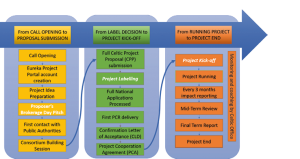
The timeline of this call is shown in the figure.

Information about the call, which closed on 2nd May 2022, is available on the Sustainability Call Website at https://eureka-clusters.eu/sustainability.html


Timeline of the Eureka Clusters Sustainability Call 2022


Outlook

2022 is and will remain a challenging year for many topics. Joint collaborative innovation and knowledge exchange are among the best weapons against pandemics and wars. Our ICT community is one of the best positioned to understand and support this. Cybersecurity, resilience of critical infrastructures (for example with SatCom), and misuse of ICT technologies against people and nations are certainly topics to be ranked now as absolute priorities in the new world that is in front of us. CELTIC has made a collaborative proposal to its fellow Clusters within Eureka and will try to elaborate a strategic programme in that direction towards Eureka funding bodies.

Eureka roadmap CELTIC-NEXT

H-OPTO

Reducing the Investment Uncertainty for Optical Access Networks


Ian Cooper                                            Per Odling
BT plc                                                     Lund University
ian.r2.cooper(at)bt.com                      per.odling(at)eit.lth.se


Stefan Carlsson                                      Robert Johansson
Stokab                                                      Telia Company
Stefan.Carlsson(at)stokab.se               r

Peter Elisson
Nexans Sweden AB
Peter.Elisson(at)nexans.com

The Celtic Next project H-OPTO aimed at establishing best practices and creating new knowledge in the installation, operation and maintenance of optical access networks. Until recently, most of the research effort on optical networks has mainly focussed on increasing capacities and developing new optical components. Less research has gone into analysing the overall deployment costs and the operations and maintenance costs. H-OPTO has focused on these costs with the ambition to build up practical knowledge and stay ahead of industry needs when deploying and operating such networks. While optical access networks are currently still far from ubiquitous, deployments are rapidly increasing. As these networks grow and start to age, quality and operation issues become progressively important. It is this network rollout and operational holistic view that H-OPTO brings to the world of optical fibre access.

The project set out to answer some specific questions such as: “How do optical networks age?” and “How do we transform network maintenance into a data-driven business?” These questions have largely been answered by the project. Cost savings in network maintenance have been achieved both for the optical access network and for fibre-fed commercial indoor wireless networks. The combination of optics and wireless expertise within the project has led to some notable results, including a new business model for one of the project partners, which significantly reduces both costs and the environmental impact for in-building mobile distribution. The project also had two successful forward-looking innovation strands, one looking at the techno-economics of optical access deployment (eventually this model will add 5G transport cost analysis capability) and the other looking at methods to secure a disturbance-free Wi-fi in-door environment.

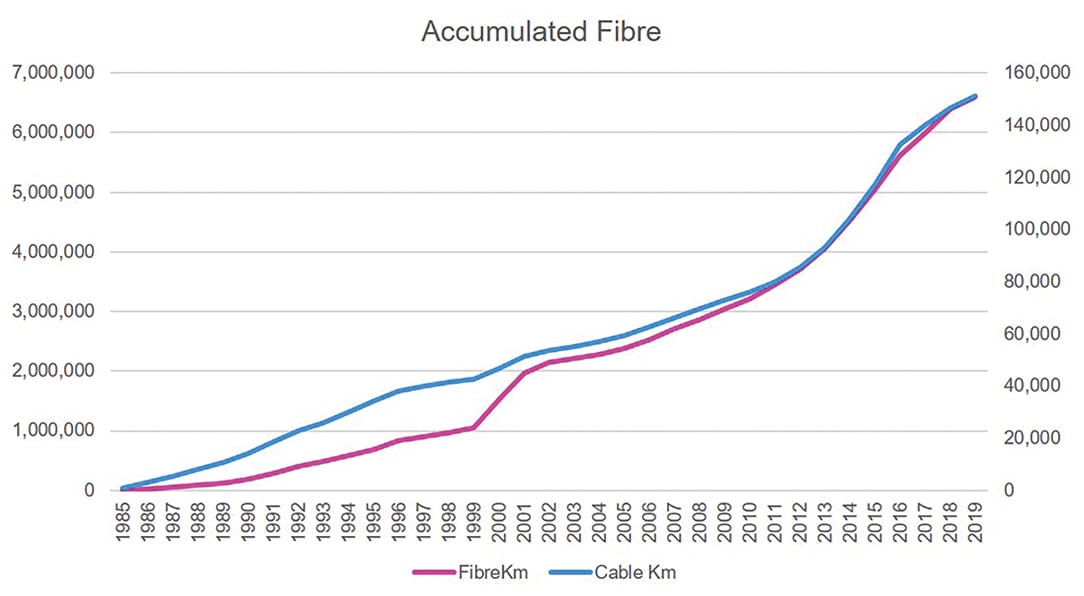
On the optics side, the project has brought together the main actors in Sweden, bringing with them their experience and expertise they have gained in deploying optical fibre networks throughout the country. Almost every home, even in rural areas, now has a fibre connection in Sweden. This expertise was combined with that from the Polish optics industry that maintains a global position in the production and testing of optical components. From the UK, BT added experts on optics, networks and techno-economics. And partners from Turkey and Sweden added further proficiency in the ­area of in-door wireless solutions including international standards experience. The success of this project is a direct result of the competence and engagement of all the participating partners. Figure 1 shows the deployment of fibre and fibre cable by Telia from 1985 until 2019 throughout Sweden.

Cables, connectors and ducts were extensively examined during the H-OPTO project, with the aim of identifying the significant reasons for network faults, which were extracted from fault logs using data mining techniques.


Fibre and fibre cable deployment in Sweden

Summary of the estimated aging of ­optical component results

Cables used during the past 25 years have not undergone any significant degradation. Cable lifetime is mostly dependent upon cable size (i.e. fibre count) and if a cable has needed to be replaced due to under-capacity. Problems noted for old cables have been related to material compatibility, which is now prevented by implemented aging tests in the qualification test programme.

Connectors are generally a weak point and cause problems for customers when high quality components are not used. However, aging has not been found to be an issue. Problems are most likely to arise due to poor fibre cleaning methods used by technicians.

Ducts: cost-wise the ducts are the most important component in a network, as re-trenching should be avoided whenever possible. Internal friction increases over time after a cable has been installed inside a duct, which can make removing cables and installing further cables difficult. However, this friction has been found to be reversible with the correct cleaning and lubrication techniques.

Conclusion and outlook

H-OPTO has been a driver in creating a new forum for technical discussions involving several different network owners in Sweden. Telia and other partners in the project have shared experience, data and quality requirements. This Swedish cooperation is expected to continue in the future, which will be beneficial for everybody connected to a fibre network within the Swedish market. In addition, other parts of the project have developed analytical cost models, investigated future network architectures based upon white-box hardware and open source software, in-home wireless interference mitigation techniques and developed remote headend mobile distribution equipment. The H-OPTO project will be continuing under the Celtic-Next banner with additional partners under the name A5gard.

› Further information
› H-OPTO project page – www.celticnext.eu/project-h-opto/

  • Previous
  • 1
  • ...
  • 5
  • 6
  • 7
  • Next

5Copyright © 2025 by Eurescom

 
  • Corporate Information
  • Data Protection Declaration
  • Terms of Use
  • Corporate Information
  • Data Protection Declaration
  • Terms of Use