As we pave the way for 6G, striking a balance between technological progress and environmental preservation is crucial. This next generation wireless technology advancements must not come at the expense of our planet. By fostering collaboration, driving innovation, and by embracing sustainable practices, we can ensure that 6G becomes a model of responsible technological progress.
In a recent publication in the Telecommunicaion Policy Journal, Programme manager Anastasius Gavras, Eurescom contributes to present the concept of Key Value Indicators (KVIs) as a method for analyzing the values-related outcomes stemming from ICT developments. Leveraging established definitions, frameworks and value identification methods, the paper proposes a structured KVI framework tailored to the ICT research and development (R&D) sector. The proposed framework comprises five steps, starting from the use case-related identification of values to the assessment of value outcomes. ICT-enabled smart cities are analyzed as an example use case to illustrate how this framework can be applied. The KVI framework is aimed to be a useful tool for the ICT research sector (to be used – primarily but not exclusively – by ICT research projects and programs) to address social challenges in technology design and development phases and to identify and estimate value outcomes from technology use. In addition, the proposed framework aims to assist policy makers to establish value-related targets and set requirements and conditions for ICT developments.
If this interests you and you seek for an exchange then feel free to drop a mail to .
With the zeal to present on the importance of aligning technological advancements with societal values and sustainable development goals, programme manager Anastasius Gavras, Eurescom presented at the 1st International Workshop on Open Research Infrastructures and Toolkits for 5G/6G R&D (OpenRIT 6G) in scope of SNS project 6G-SANDBOX Project on the “Stimulation of an evolution of test and experimentation infrastructures to measure value”.The presentation evolved around the framework for values-driven development to introduce a method to measure value-related impacts based on Key Value Indicators (KVIs) in the context of emerging 6G technologies. The KVI framework delineates certain steps, ranging from defining use cases to evaluating value outcomes, thereby offering a structured approach for research and development of 6G technologies. The ultimate aim is to empower RTD projects on future communications systems to address environmental, societal, and economic challenges and estimate value outcomes.
If this interests you and you seek for an exchange then feel free to drop a mail to .
Keywords
6G Technology, technological advancement, Key value indicators, Impact, Research development
The Eurescom led ESA project 5GEOSiS – 5G Earth Observation Server in Space will provide a tutorial with the title “Joint Communication and Sensing for Space: Understanding the Convergence of Space Functions through employing repurposable payloads” as part of the 4th IEEE International Symposium on Joint Communications & Sensing . The tutorial will provide the basic elements to understand the requirements, system concepts and potential benefits of Joint Communication and Sensing from Space.The event is scheduled on 19 March in Leuven that will also be streamed.
The EU-funded, EURESCOM coordinated project ARIADNE advances the research on new system by integrating a high frequency advanced radio architecture and an artificial intelligence (AI) network processing and management approach. This ambitious goal focuses on a long-term vision of pervasive mobile virtual services instead of local network improvements for the current 5G standard.
The project considered general use cases, including connections between rooftop locations and at street-level, and RIS-based connectivity without a direct line of sight. It also looked at dynamic ad hoc connectivity in a moving network, besides vehicle-to-vehicle and vehicle-to-everything connectivity, crucial for applications such as autonomous driving. According to Halid Hrasnica, project coordinator the ARIADNE concept and its achievements need to be further developed to be integrated in future wireless communication networks. “To achieve this, the project’s industry partners are already taking the related concrete actions.”
The new #6G book titled “Towards Sustainable and Trustworthy 6G – Challenges, Enablers and Architectural Design” is the first book on 6G providing a truly #European point of view on the currently ongoing race towards the #standardization of the new generation of telecommunications system. Experts from Eurescom, namely Anastasius Gavras, have contributed to this book.
It covers all the aspects related to the main #research#trends in the current phase, from architectural insight, to sustainability, slicing, with a view on the foreseen timeline towards standardization. With the participation of many EU-funded projects over the last years and capitalizing on the 5G Public-Private-Partnership (#5GPPP) Phase 3 projects in a joint effort between the Architecture Working Group and the EU flagship Hexa-X, this book delves into the critical challenges and enablers of the 6G system, including new network architectures and novel enhancements as well as the role of regulators, network operators, industry players, application developers, and end-users.
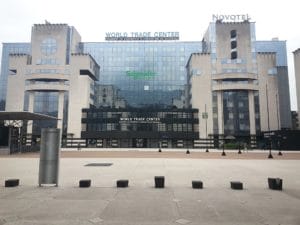
WTC Grenoble – Photo: Hugo Cacaud, License: CC BY-SA 3.0
The 2022 EuCNC & 6G Summit builds on putting together two successful conferences in the area of telecommunications: EuCNC (European Conference on Networks and Communications), supported by the European Commission, and the 6G Summit, originated from the 6G Flagship programme in Finland, one of the very first in its area. The conference is sponsored by the IEEE Communications Society and by the European Association for Signal Processing. It focuses on all aspects of telecommunications ranging from 5G deployment and mobile IoT to 6G exploration and future communications systems and networks, including experimentation and testbeds, and applications and services. It brings together cutting-edge research and world-renown industries and businesses, globally attracting in the last years more than 1,300 delegates from more than 40 countries all over the world, to present and discuss the latest results, and an exhibition with more than 70 exhibitors, for demonstrating the technology developed in the area, namely within research projects from EU R&I programmes.
Eurescom is planning to be involved in the conference programme and the exhibition via several EU-funded projects.
Eurescom leads the Horizon Europe project SNS CO-OP, which is selected to support and enhance the Smart Networks and Services initiative by coordinating the strategic activities that capture and promote the European industry’s vision for 6G.
Through the lighthouse project SUSTAIN-6G, led by Nokia, Eurescom collaborates with a consortium of leading innovators and industrialists to develop a strategy for a sustainable future for ICT and the communications infrastructure at large. This includes developing technologies that prioritize environmental, economic, and societal sustainability for all future services.
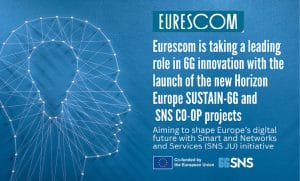
Eurescom, a leading European provider of management and support services in the high-tech area, marks the launch of two pivotal collaborative research projects in January 2025. Under the umbrella of Smart Networks and Services Joint Undertaking (SNS JU), these projects aim to solidify and improve European leadership in 6G technology, fostering a sustainable, inclusive, and innovation-driven network ecosystem that supports the EU’s long-term ambitions for universal next-generation technologies.
SNS CO-OP: SNS COLLABORATIVE OPERATIONS AND OUTPUT OPTIMISATION
SNS CO-OP is dedicated to coordinating strategic activities and aligning industry efforts across the currently, 78 projects of the SNS JU. In order to advance European initiatives in smart communications networks and next-generation technology, SNS CO-OP will amplify the achievements of SNS projects, highlight Europe’s leadership in 6G, by building on the successes of the previous support activities in the SNS OPS and SNS ICE projects. SNS CO-OP will ensure that the impact of the SNS JU continues to evolve and expand by supporting future phases of 6G development across the EU and beyond.
The SNS CO-OP consortium, is composed of 22 key partners,and will be led Uwe Herzog, Programme Manager, Eurescom. This project will ensure a seamless transition of the SNS support activities for the next two years. The carefully structured work plan of SNS CO-OP is designed to support and assist delivering the global impact of the key 6G developments as envisioned in the SNS work programme. It will establish and maintain a dialogue in the wider European 6G SNS community to consolidate the European Industry view on 6G and to promote the European vision around the world.
SUSTAIN-6G: SUSTainability-Advanced and Innovative Networking with 6G
SUSTAIN-6G aims to ensure that future 6G networks contribute to sustainable growth across key sectors. This unique approach will examine sustainability impacts across the full life-cycle of 6G technology, and apply the developed insights across multiple vertical sectors. By identifying key intersections between sustainability needs and the capabilities of 6G, the project will clarify the ways in which 6G can be used to responsibly drive economic and societal benefits.
SUSTAIN-6G’s mission is clear: to make sustainability integral to the design, deployment, and operation of 6G networks. SUSTAIN-6G will help shape a more sustainable, resilient, and inclusive digital future.
Together, SNS CO-OP and SUSTAIN-6G represent a significant part of the unified European SNS Initiative to advance 6G networks that are highly performant but also resilient and responsible. While SNS CO-OP will foster collaboration and strategic alignment across the large and diverse 6G SNS community, SUSTAIN-6G will bring a focused approach to sustainable technology development, considering both the immediate and long-term impacts of 6G technology on society, the environment, and the economy.
This article presents the European perspective, represented by the 6G Smart Networks and Services Industry Association (6G-IA), on Europe’s proactive role in 6G Research and Development (R&D) and standardisation, ad[1]dressing societal, environmental, economic and market challenges.
The exchange with the Expert from Nokia, presents his perspective on sustainability and how these aspects address requirements from a large number of use cases coming from different stakeholders.




 Further information