Dual-Use Drones and the European Governance Challenge: presents the rising drone incursions across Europe and reveals a new dual-use threat built on civilian ICT infrastructure, blurring civil-military boundaries and exposing governance gaps.
Continue reading2nd EU-Japan Digital Week highlights shifting priorities and focus towards dual use technologies and even defence
2nd EU-Japan Digital Week highlights shifting priorities and focus towards dual use technologies and even defence – policy workshop highlighted growing geopolitical risks and the need for resilient, trusted connectivity.
Continue readingEURO-3C: Building Europe’s Federated Telco-Edge-Cloud Future
EURO-3C (€75M) aims to build a federated Telco-Edge-Cloud infrastructure, strengthening sovereignty and resilience. This reflects shifting ICT priorities toward interoperable, secure, AI-enabled ecosystems that address fragmentation, support critical sectors, and
ensure scalable, trusted digital infrastructure across Europe and Eurescom is committed to contribute to this strategically important initiative.
FORTRESS: Building Europe’s Quantum-Safe Future through Hybrid Secure Boot Innovation
FORTRESS project develops a scalable hybrid secure boot architecture designed for Europe’s evolving digital infrastructure that combine traditional and post-quantum algorithms. By combining cryptographic research, and ecosystem collaboration, the project
contributes to shaping secure and resilient European digital future.
Strengthening Europe’s media sovereignty with the Future Media Initiative
Strengthening Europe’s media sovereignty with the Future Media Initiative presents the growing gap between content creation and platform control and how this is a core issue for European media sovereignty.
Continue readingEditorial
Dear readers,
In the rapidly evolving geopolitical and technological landscape, resilience has moved from a technical consideration to a strategic imperative. This shift is reflected in the recent announcement by the European Commission, which unveiled a €115 million AGILE programme in March 2026—an ambitious initiative designed to accelerate disruptive defence innovation across Europe. By targeting technologies such as artificial intelligence, quantum systems, and drones, and by empowering SMEs, start-ups, and scale-ups, AGILE signals a decisive move: innovation must not only be fast, but deployable, scalable, and resilient in real-world conditions.
This evolving priority is at the heart of this edition of Eurescom Message. It brings together a spectrum of perspectives that reflect sector expertise, practical insight, and long-term impact. From governance challenges to architectural transformations, the focus is clear—Europe’s ICT future must be robust, adaptive, and secure by design.
The Kennedy’s perspective forces us to reflect on how we interpret reality, often limiting our ability to see beyond personal bias. In today’s digital age, this challenge is amplified, highlighting the urgent need for more resilient and trustworthy ICT systems.
The invited article on the Dual-Use Drones and the European Governance Challenge alerts on the rising drone incursions across Europe and reveals a new dual-use threat built on civilian ICT infrastructure, blurring civil-military boundaries and exposing governance gaps. While strengthening resilient networks, spectrum management, and integrated 5G/6G capabilities is now critical for security and societal stability.
A glimpse from the 2nd EU-Japan Digital Week highlights shifting priorities and focus towards dual use technologies and even defence – policy workshop highlighted growing geopolitical risks and the need for resilient, trusted connectivity. Discussions focused on AI, quantum, and space technologies, emphasising joint R&D, interoperable standards, secure supply chains, and strengthened cooperation for a rules-based digital order.
At Mobile World Congress 2026, the European Commission launched EURO-3C (€75M) to build a federated Telco-Edge-Cloud infrastructure, strengthening sovereignty and resilience. This reflects shifting ICT priorities toward interoperable, secure, AI-enabled ecosystems that address fragmentation, support critical sectors, and ensure scalable, trusted digital infrastructure across Europe and Eurescom is committed to contribute to this strategically important initiative. With our long-standing experience in organising and supporting large-scale European research and innovation programmes, we ensure the smooth implementation and effective operational set-up of EURO-3C.
European policy and cybersecurity authorities have increasingly advocated for hybrid cryptographic strategies that combine traditional and post-quantum algorithms. The Eurescom led, EU funded FORTRESS project directly addresses this strategic challenge by developing a scalable hybrid secure boot architecture designed for Europe’s evolving digital infrastructure. By combining cryptographic research, and ecosystem collaboration, the project contributes to shaping secure and resilient European digital future.
The article on Strengthening Europe’s media sovereignty with the Future Media Initiative presents the growing gap between content creation and platform control and how this is a core issue for European media sovereignty. This shift from content creation towards the control of digital infrastructure, data, and monetisation now requires resilient, European-led platforms, stronger innovation capacity, and coordinated investment to reduce dependency on non-European tech giants and safeguard democratic influence, competitiveness, and trusted information ecosystems in an increasingly platform-driven digital landscape.
This edition demonstrates, Europe is actively reshaping how it approaches ICT—prioritising resilience, integration, and long-term impact. In doing so, it reinforces a fundamental truth: connectivity is never just infrastructure. It is a shared responsibility.
This edition is Special as we extend our sincere appreciation to the Director of Eurescom for his outstanding leadership and long-standing dedication to Eurescom. Over the years, his vision, commitment, and strategic direction have played a pivotal role in shaping Eurescom into a respected and impactful organization within the telecommunications and research community. Through his guidance, the organisation has not only strengthened its position but also expanded its influence, fostering collaboration, innovation, and excellence across diverse initiatives. Beyond organisational success, his leadership has inspired colleagues, partners, and stakeholders alike, leaving a lasting impression on all who have had the privilege to work with him. As he steps into a new chapter, we warmly acknowledge the legacy he leaves behind—one defined by growth, resilience, and achievement. We wish him continued good health, happiness, and a fulfilling future, with ample time to enjoy new opportunities and personal pursuits.
With this edition of Eurescom’s Message we continue our mission to reach the ICT European community for sharing insights and perspectives that shape the future of connectivity. We warmly invite your feedback and ideas for upcoming issues. Write to us at and let us know which topics you’d like us to explore next. Your input helps us make each edition more relevant, inspiring, and impactful.
Enjoy reading!
Pooja Mohnani
Editor-in-chief
Words from the Director
What CELTIC-NEXT has delivered in the first half of 2026
and what is coming for the rest of the year?
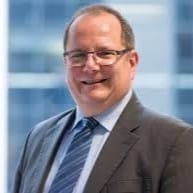
Xavier Priem
Director CELTIC Office
priem@celticnext.eu
For CELTIC-NEXT, 2025 was a year of successful renewal. The 2nd EUREKA Clusters’ Programme started in July 2025, and our new, updated SRIA has enabled future successful innovation support and change since December 2025. Let’s look at what was achieved in the first half of 2026 and what we plan for the rest of the year 2026.
2026’s first half’s achievements
Since the renewal of our license to operate our Cluster under the EUREKA flag, we have been working to deliver the promised alignments and changes among the clusters and with the Funding Bodies of the EUREKA Network. This encompasses a dedicated webpage on the “Fees”, alignment of the proposals’ evaluation template across the clusters, and the ramp-up of a “Market Impact Report” survey mailing to projects that ended 18 and 36 months ago (to capture the impact of public funding on participants). We are also working with the other EUREKA Clusters on developing an internal operational handbook for cluster processes to help new Funding Bodies support us, the Clusters, and, therefore, you in funding your consortia in additional countries.
We had a great Proposers’ Brokerage Day in Vienna, Austria, at the end of January, with a very good attendance, fifteen pitches of innovative ideas, and lots of discussions. The Labelling meeting will happen in the first half of June 2026. Labelling decisions will be communicated before the end of June.
The end of this first half of 2026 sees the end of my role as Clusters Coordinator for the Industry. It is a rotating ambassador and coordination role, serving as the one voice of the clusters to the EUREKA Chair Country(ies) during the same period (July to June). It was an amazing period where I learnt a lot about the role of the EUREKA Chair Country, the responsibility for them to organise and manage the EUREKA Network, but also the incredible “race against the clock” exercise it is. I now have a better understanding of the EUREKA Network’s internal workings, the different stakeholders, the diversity of countries’ opinions, and, at the same time, their capacity to reach consensus-based decisions and actions, knowing that the EUREKA Network is larger than the European Community and includes countries from four continents! And despite this size, it feels like a family when we meet at the quarterly EUREKA Network meetings. Why? Because all those countries and their delegates are guided by this one fundamental principle: enabling innovation and its return of value for the EUREKA societies via international cooperation. My mandate will terminate at the end of June 2026, in sync with the end of the Swiss Chairmanship. The new EUREKA year 2026-2027 will be guided by Belgium, taking over from Switzerland. A newly appointed Clusters Coordinator for the Industry will take over from me.
Outlook for 2026 second half
At the EUREKA Clusters Programme’s level, the work will continue: the alignment of processes, the optimisation of synchronisation of funding decisions, and the inclusion of more countries to fund clusters’ calls and projects.
At CELTIC-NEXT’s level, we will open the Autumn Call 2026 in the first week of July, plan a Proposers’ Brokerage Day at the beginning of September, and set the call-for-proposals deadline for the 23rd of October 2026. We will decide upon the labelling at the beginning of December 2026. Please stay tuned by visiting our Call Calendar page: https://www.celticnext.eu/call-calendar/ and/or by subscribing to our Newsletter under https://www.celticnext.eu/news-subscription/
Further information
- Stay tuned by visiting our Call Calendar page: https://www.celticnext.eu/call-calendar/ and/or
- by subscribing to our Newsletter under https://www.celticnext.eu/news-subscription/
3D-NET: Building Europe’s 3D Connectivity Future
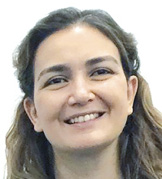
Cicek Cavdar Mustafa Ozger Dominic Schupke
KTH Royal Institute of Technology KTH Royal Institute of Technology Airbus
Introduction
3D NETworks for 6G Mobile Communications Applications (3D-NET) project aims to position Europe’s next connectivity step as a true three-dimensional network rather than a loose coexistence of ground, air, and space systems. The project starts from a basic reality. Globally, nearly 2 billion people still have no access to mobile connectivity services, and only about 10% of the world’s landmass is covered by cellular or fibre infrastructure. Satellite systems can extend reach, but today they often depend on dedicated terminals, remain costly, and support only a limited number of users. At the same time, future services are becoming more demanding. Remote industrial control, emergency response, connected vehicles, aviation services, and autonomous systems all require connectivity that is continuous, reliable, and readily available.
This is why 3D-NET argues for a unified European architecture across terrestrial networks, non-terrestrial networks, and airspace platforms. The project is not simply about adding satellites to mobile networks. It is about creating a standard-compliant and validated communication fabric that can deliver service continuity from ground to sky for both human and machine-type users. In that sense, 3D-NET may serve for a broader European direction: seamless 3D connectivity as a foundation for future mobility, digital industry, and technological sovereignty.
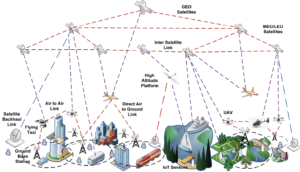
Figure 1. 3D-NET reference architecture across terrestrial with relevance also to selected maritime scenarios, as well as airspace, and non-terrestrial network domains, showing integrated links, platforms, and example application environments.
Architecture and use cases
The central idea of 3D-NET is architectural integration. Today’s terrestrial, aerial, and satellite systems are still designed, operated, and optimised too separately. That fragmentation becomes a serious problem when users move across domains or when the service is mission-critical. A drone or uncrewed aerial vehicles (UAV), flying beyond urban coverage, an aircraft requiring resilient broadband, or an industrial operation in a remote area cannot depend on disconnected technology islands. Figure 1 illustrates this integrated system context across ground, air, and space, combining satellites, high-altitude platforms, UAVs, terrestrial base stations, edge computing, and representative urban and rural scenarios.
3D-NET therefore proposes one 3D architecture with joint resource optimisation across ground, air, and space segments. It addresses not only radio access, but also orchestration, computing, caching, and service continuity. This creates a stronger basis for a wide range of use cases: broadband and IoT in remote regions, resilient communication for disaster and public safety scenarios, digital support for low-altitude economy services such as drones, helicopters and electric vertical take-off and landing aircraft (eVTOLs), and high-data-rate mobile services for users moving from ground to sky. In practical terms, the project frames connectivity as an end-to-end system problem rather than a single-link problem.
Mobility management from ground to sky
Mobility is one of the clearest areas where the need for a new model becomes visible. Classical mobility management was built for users moving on the ground between terrestrial cells. In 3D environments, however, users move not only horizontally but also vertically, across altitude layers, radio technologies, and even orbital segments. Aerial users often see many base stations at once, which can create unstable associations, unnecessary handovers, and service interruption.
Building on earlier work in CELTIC-NEXT project 6G-SKY project, 3D-NET takes this problem further by targeting seamless vertical and horizontal handovers across integrated terrestrial, airspace, and non-terrestrial domains. The aim is not only to reduce signalling overhead or handover failures. It is to sustain service availability for delay-sensitive and mission-critical applications, including live sensing, control traffic, and industrial operations. The project also creates room for learning-based mobility management, but with the understanding that future operational systems must be explainable, dependable, and compatible with standardisation and regulatory requirements.
Positioning, sensing and localisation
A second major contribution of 3D-NET is the convergence of communication with positioning and sensing. Future networks should not only transport data; they should also help devices understand where they are, what surrounds them, and how reliably they can act. This is especially important for autonomous or semi-autonomous systems operating in safety-critical environments.
The project therefore targets robust positioning, sensing, and localisation through integrated networks. This includes resilient navigation beyond conventional Global Navigation Satellite System (GNSS)-only operation, the use of low Earth orbit support, 6G mmWave systems, inertial sensing, vision, and multi-sensor fusion. At swarm level, localisation becomes both an individual and collective problem: each UAV must know its own position, while the swarm as a whole must maintain shared situational awareness. 3D-NET treats this as part of the network design itself. In parallel, integrated sensing and communication can strengthen localisation, tracking, and environment awareness, which is highly relevant for air traffic management, traffic monitoring, infrastructure inspection, and public safety.
Computing, caching and the Internet of Remote Things
3D-NET also expands the discussion beyond connectivity into distributed computing and service execution. Many future applications in remote or infrastructure-less areas will depend on where data is processed, how quickly it can be cached or forwarded, and how tasks are shared between edge, cloud, airborne platforms, and satellites. A network that only forwards bits is no longer sufficient.
For this reason, the project explicitly includes real-time and non-real-time computing and caching services. This is particularly important for the Internet of Remote Things, where sensing, control, and analytics must continue even in areas with weak or intermittent terrestrial coverage. The same applies to industrial and mobility applications in which response time, task offloading, and data freshness directly affect safety and performance. By addressing computing and caching together with communication, 3D-NET moves from a coverage-centric view to a service-centric one.
Energy efficiency, demonstrations and European relevance
A unified 3D system will only be credible if it is also sustainable. 3D-NET therefore treats energy efficiency as a cross-cutting design objective across the full ground-air-space continuum. The project is not looking for wider coverage at any cost. It is looking for scalable and realistic solutions that can balance coverage, performance, and resource use for operators, service providers, and vertical sectors. This matters not only for climate and operating cost, but also for the long-term viability of integrated 6G infrastructures.
To make this credible, 3D-NET plans technology demonstrations adapted to the maturity of the individual components and use cases. That is important because Europe does not need another abstract architecture paper alone. It needs validated solutions that can bridge research, industrial deployment, and standardisation. In this sense, 3D-NET builds directly on outcomes from 6G-SKY, BMBF 6G-TakeOff, and the Air Mobility Initiative. It also aligns with a wider European need for interoperable and sovereign capabilities across terminals, network software, airspace systems, and satellite communications. Within CELTIC-NEXT, 3D-NET can be seen as an important seed for a broader flagship strand on terrestrial, airspace, and non-terrestrial convergence.
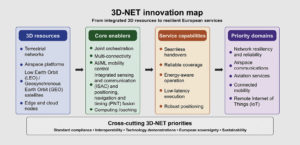
Figure 2. Proposed innovation map linking 3D-NET resources, enablers, capabilities, and priority application domains.
Conclusion
3D-NET is timely because it addresses a structural gap in current network evolution. The future challenge is no longer only how to increase peak rate in dense urban cells. The larger challenge is how to deliver continuous, trustworthy, and efficient services across heterogeneous environments, users, and infrastructures. Europe needs a connectivity model that supports future mobility, remote industry, resilient public services, and new digital business models without reinforcing fragmentation between ground, air, and space domains.
That is the strategic value of 3D-NET. It turns 3D connectivity from an aspirational slogan into an engineering agenda: one architecture, network resiliency, coordinated mobility, integrated positioning and sensing, distributed computing, energy-aware design, and standard-compliant demonstrations. If successful, it will help position Europe not only as a user of future 3D networks, but as a builder of them.
Outlook
The wider significance of 3D-NET is that it gives Europe a concrete way to organise several fast-moving trends under one technical and strategic framework. These trends include the low-altitude economy, multi-orbit satellite services, explainable and trustworthy AI for network control, resilient positioning beyond GNSS-only assumptions, and service continuity for industrial digitalisation outside urban hotspots. Instead of treating these as separate innovation threads, 3D-NET binds them into one programme logic.
This is also why the project matters beyond its own consortium. If Europe wants open, interoperable, and standard-driven solutions across chipsets, terminals, airspace systems, and network software, it needs integrative projects that connect research, demonstrations, and standardisation. 3D-NET is designed to play exactly that role. Figure 2 summarises this programme logic, showing how integrated 3D resources are translated into technical enablers, service capabilities, and priority European application domains.
Further information
Recent news

INPACE – EU–Japan Digital Week 2026
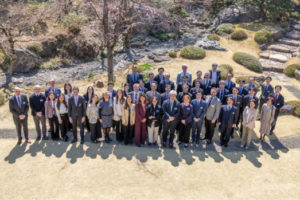
Group picture after the Policy Workshop on Tuesday 24 March 2026.
Like previous years, EU–Japan Digital Week was held in Tokyo. The INPACE project initiative contributed to strengthening cooperation on emerging digital technologies, including AI, semiconductors and quantum computing. Eurescom was directly involved in the “Advancing EU–Japan Digital Cooperation: Insights from the Week and Next Steps” workshop session, co-organised by Adam Kapovits, Project Manager at Eurescom and Dr Stevana Klessove, GAC Group, which session was session for learning across topics, making new connections, and understanding what comes next in EU-Japan digital cooperation.
The session combined concise insights from organisers, live hackathon pitches demonstrating interoperable digital public infrastructure solutions between Europe and Japan, and forward-looking exchanges on future collaboration. It provided a clear view of how EU–Japan cooperation is evolving from dialogue to concrete joint actions, with a focus on interoperability, trusted data spaces and long-term research partnerships.
- NPACE EU–Japan Digital Week 2026: https://inpacehub.eu/eu-japan-digital-week-2026/#schedule
WiTaR – Advancing Inclusion in 6G Research
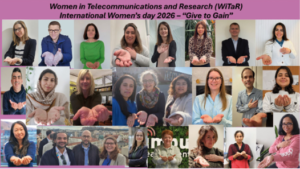
WiTaR annual postcard for the International Women Day 2026 on the theme “Give to Gain”
The WiTaR working group initiative continued to promote inclusion and gender balance within the 6G research and innovation ecosystem. Marking International Women’s Day 2026, WiTaR reaffirmed its commitment to increasing the visibility and participation of women across technical and leadership roles. This year campaign was “Give to Gain”. The ongoing effort of the working group is further supported through its Lunch Salon series, with the recent fourth edition focusing on the inTRUSTED project and the role of trust and inclusivity in future digital ecosystems. Through these regular exchanges, WiTaR provides a practical platform to address skills gaps, encourage diverse participation in standardisation and research, and contribute to a more balanced and representative 6G community.
- WiTaR 6G-IA working group: https://6g-ia.eu/witar/
SUSTAIN-6G – Photonics for Sustainable ICT 2026
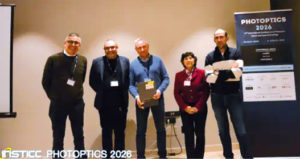
Best Paper Honorable Mention awarded to the SUSTAIN-6G paper “Photonic Continuity: Sustainable Wired and Wireless Photonics from kilobits per second (kbps) to Petabits per second (Pbps)”, authored by Olivier Bouchet, Yanes Yahoui, Guillaume Vercasson, Vincent de la Broise, Irene Kolokytha, and Sokratis Barmpounakis.
The SUSTAIN-6G project was actively involved in the PHOTOPTICS 2026 conference, where a dedicated workshop on “Photonic Technologies for a Sustainable ICT” explored the role of advanced optical technologies in reducing the environmental impact of future networks. The session brought together keynote and invited speakers to address challenges related to energy consumption, lifecycle assessment and sustainable system design.
Contributions ranged from methodological approaches for evaluating environmental impact to technical innovations in optical transmission and data centre interconnections. The recognition of a SUSTAIN-6G paper with a Best Paper Honorable Mention further highlighted the project’s contribution to advancing sustainable solutions in next-generation communication systems.
- SUSTAIN-6G workshop at PHOTOPTICS 2026: https://sustain-6g.eu/events/workshop-at-photoptics-2026-photonic-technologies-for-a-sustainable-ict/
EURO-3C – Building Europe’s Telco-Edge-Cloud Infrastructure
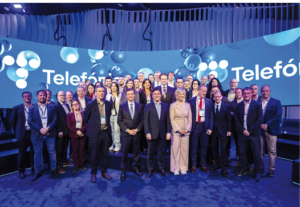
EURO-3C unveiled at MWC 2026
The EURO-3C project, recently announced by the European Commission with a budget of €75 million under Horizon Europe, represents a significant step towards strengthening Europe’s digital sovereignty. Bringing together 87 partners from across the telecommunications, cloud and research sectors, the project aims to develop a federated Telco-Edge-Cloud infrastructure capable of supporting advanced digital services across Europe.
- EURO-3C project announcement: https://digital-strategy.ec.europa.eu/en/news/commission-announces-eu75-million-euro-3c-project-build-federated-telco-edge-cloud-infrastructure
Sn@pshot
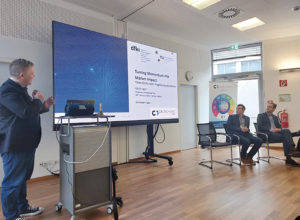
At the CELTIC-NEXT Proposers’ Brokerage Day in Vienna, discussions centred on how ongoing collaborative research is progressing towards concrete market applications. Within the Business Impact Session, Christoph Lipps from DFKI presented the results of the flagship projects SENDATE, AI-NET and SUSTAINET. These examples illustrated how coordinated efforts across industry and research are already contributing to developments in secure connectivity, sustainability and next-generation digital services.
More broadly, the event provided a structured platform for exchange between stakeholders across the CELTIC-NEXT community. The programme included 14 formal presentations across welcome remarks, keynote and national framework sessions, contributions from 11 public authorities and funding bodies, and 15 project pitches presented during the dedicated pitching sessions. Together with the follow-up consortium building meetings, this level of participation underlined the role of CELTIC-NEXT as an effective framework for fostering collaboration and preparing the next generation of transnational R&D projects.
 Further information
https://www.celticnext.eu/proposers-brokerage-day-30-january-2026-in-vienna/
>>>See also CELTIC-NEWS
CELTIC-NEXT Proposers’ Brokerage Day in Vienna: Christoph Lipps
(Senior Researcher at DFKI) presenting the success stories of the
CELTIC-NEXT Flagship Projects SENDATE, AI-NET, and SUSTAINET